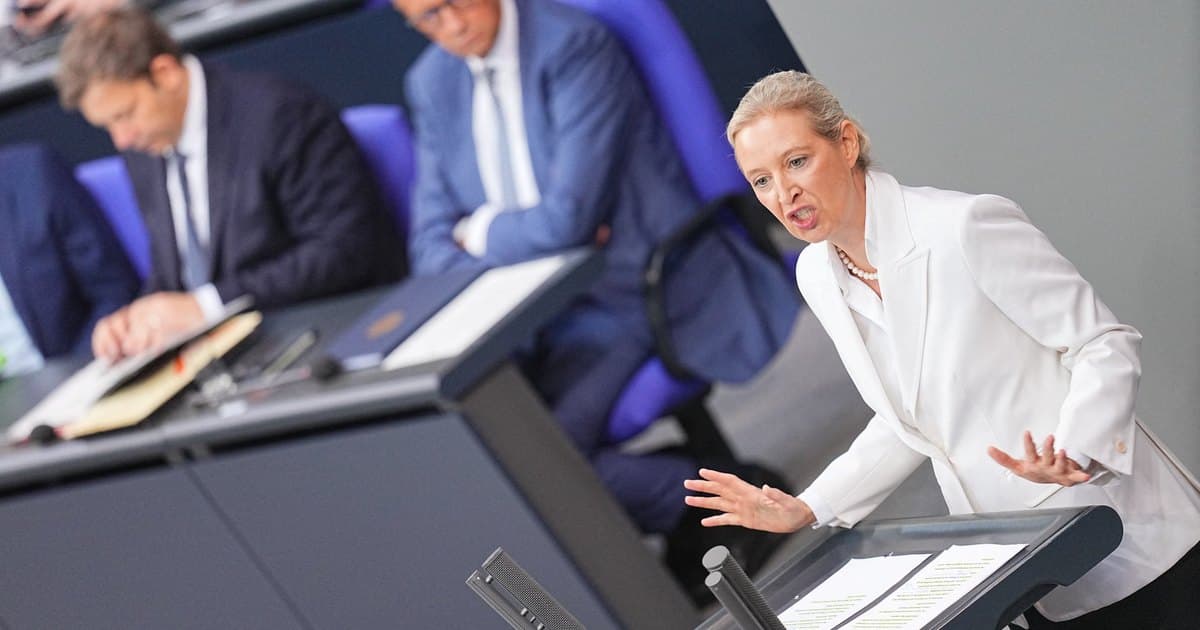
AfD taunts Merz in Bundestag after landmark state election victory
AfD's Weidel taunts Chancellor Merz in parliament after a big state election win; Merz hits back, calling the party a 'destructive force'.
Berlin witnessed a fiery parliamentary clash on Wednesday as the co-leader of the far-right Alternative for Germany (AfD) taunted Chancellor Friedrich Merz following the party's historic victory in a regional election.
Opening the annual budget debate, AfD co-chair Alice Weidel directly addressed the Chancellor, asserting that voters in Saxony-Anhalt had delivered a clear verdict against his coalition. "In Saxony-Anhalt, people didn't just punish you, they pulverized your party," she said, adding that the CDU is becoming a minor party at the federal level.
Weidel claimed the Chancellor had failed to grasp the message from the electorate and declared that his time was running out. "Citizens want a change of policy and they will get it," she stated, predicting that future elections would deliver a clear mandate for her party to govern.
Chancellor Merz, whose CDU suffered a significant loss of support in the eastern state, responded combatively. While acknowledging the AfD's result as "remarkable," he pointed out that the party had failed to secure the absolute majority it had aimed for. "You don't have the absolute majority, and you won't achieve it in Germany," Merz told Weidel, calling her a "destructive force."
The Chancellor also launched a sharp attack on the AfD's use of the term "remigration," which he equated with ethnic cleansing. "The word 'remigration' is nothing but a synonym for ethnic cleansing according to origin and skin color," he argued, warning that such policies would cripple essential sectors like healthcare and hospitality that rely on migrant workers.
The election result in Saxony-Anhalt, which saw the AfD surge to its biggest win yet, has intensified pressure on Merz's government as it grapples with a sluggish economy and migration concerns. The outcome has drawn attention from far-right parties across Europe and a social media post from U.S. President Donald Trump, who praised the populist surge.
With two more state elections scheduled for September 20 in Berlin and Mecklenburg-Western Pomerania, the political fallout from Sunday's vote is likely to continue shaping the national debate.