Andhra University to set up Centres of Excellence in quantum tech, AI, semiconductors
Andhra University plans Centres of Excellence in quantum technology, AI and semiconductors, announced at the QUEST-AI conference in Visakhapatnam.
Andhra University will establish Centres of Excellence in quantum technology, artificial intelligence systems, and semiconductors over the next two to three years, Vice-Chancellor G.P. Raja Sekhar announced on Tuesday.
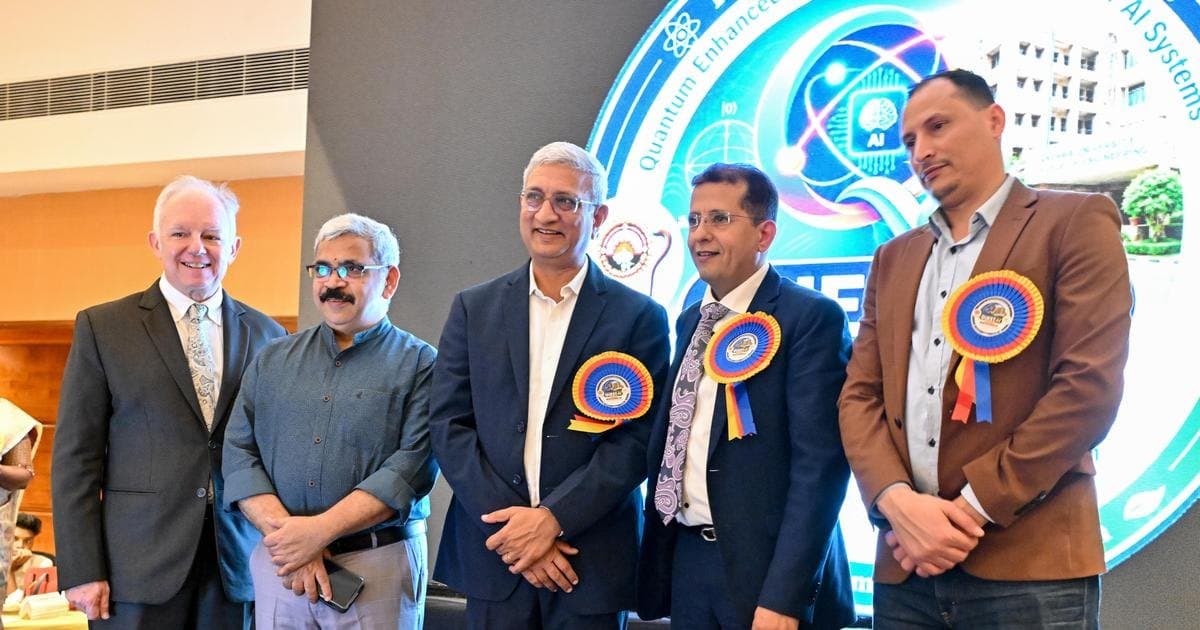
Speaking at the inauguration of the three-day international conference on Quantum-Enhanced Sustainable Technologies for AI Systems (QUEST-AI) in Visakhapatnam, Mr. Raja Sekhar said the university, having concluded its centenary celebrations, is now shifting focus to quality developmental activities. He stressed that research in quantum technology and AI must move beyond theory and be translated into practical solutions for society.
Delivering the inaugural address, K.N. Satyanarayana, Director of IIT Tirupati, noted that the Union government has launched the National Quantum Mission with an outlay of ₹6,000 crore. He said quantum computing is unlikely to replace classical computing, and the more probable path is a hybrid model where both work together. Mr. Satyanarayana added that Andhra Pradesh has the opportunity to build an integrated quantum-AI ecosystem, bringing together government, academia, industry, start-ups, and partners such as IBM and TCS.
Highlighting the local relevance, Mr. Satyanarayana pointed out that Visakhapatnam is emerging as a hub for data centres, which are essential for AI. He cautioned that such facilities consume significant energy and water, making sustainability a central concern.
Marwan Dhamrin, Professor at Osaka University's Graduate School of Engineering, called for stronger India-Japan research collaboration and suggested India should build what industry terms a "vertically integrated society for semiconductors and AI."
Nabil Mohammed, Lecturer at Federation University, Australia, said clean energy and data centres must develop in tandem, posing the challenge of generating more electricity from sustainable resources to power future facilities. Gregory J. Skulmoski of Bond University, Australia, said India is well positioned to address the global shortage of skilled professionals in quantum technologies.
K. Venkata Subbaiah, Principal of AUCE (A), welcomed the guests. Conference chair V. Valli Kumari, Dean (R&D) and Head of the Department of Computer Science and Systems Engineering, said about 60 papers have been selected for presentation across technical departments, with around 300 participants expected. The conference, organised with RUSA 2.0 funding, is the first of its scale involving the cluster departments and will be held annually.