The Arctic Race: Why Russia, China and the US Are Competing for the Frozen North
Climate change is making the Arctic accessible, intensifying a strategic rivalry between Russia, China, NATO, and the US over resources and shipping lanes.
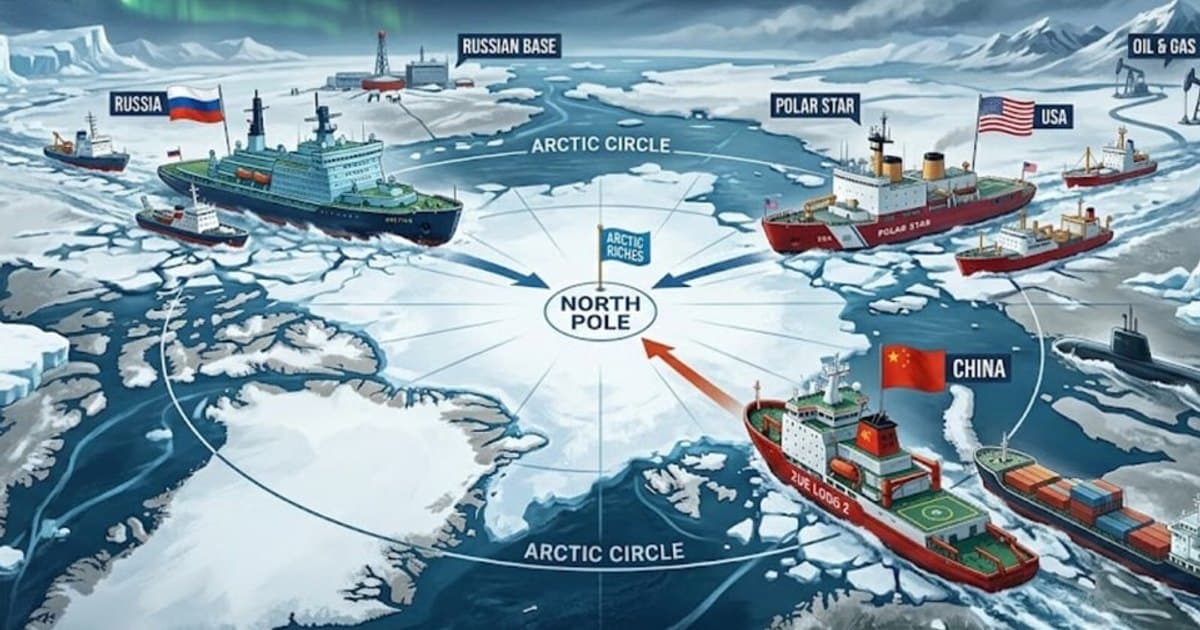
The Arctic, once a frozen frontier of scientific cooperation, is fast becoming a new theatre of great-power competition. The region's strategic importance is rising due to its location, military value, untapped resources, and the shipping routes unlocked by climate change.
Russia's Dominance Russia holds the most substantial Arctic footprint, controlling roughly half of the land and maritime zones north of the Arctic Circle. It hosts about two-thirds of the region's population and accounts for a similar share of its economic output. Moscow has spent decades reinforcing its presence, operating dozens of military sites and investing heavily in its nuclear-powered submarine fleet, radar, drones, and missile systems. While its overall capabilities do not match NATO's, the scale and speed of Russia's expansion remain a key concern for the West.
A New Strategic Fault Line The Arctic was once a zone of cooperation, with the Arctic Council (est. 1996) facilitating dialogue among the eight Arctic states. However, ties frayed after Russia's annexation of Crimea in 2014 and collapsed following its full-scale invasion of Ukraine in 2022. The subsequent entry of Finland and Sweden into NATO has redrawn the map, creating a stark strategic divide between the alliance and Russia.
The US and Greenland US President Donald Trump's repeated assertions that Washington "needs" Greenland for national security have thrust the island into the spotlight. An autonomous territory of Denmark, Greenland's location between North America and Europe makes it vital for monitoring military activity and securing access to the North Atlantic. Beyond security, the island is believed to hold significant deposits of coal, copper, gold, zinc, and rare-earth elements, though extraction in its harsh, isolated terrain remains a formidable challenge.
China's Ambitions Though it has no Arctic territory, Beijing has declared itself a "near-Arctic state" and promotes a "Polar Silk Road." China's interest lies in shorter trade routes between Asia and Europe and access to energy resources. Its growing strategic alignment with Russia, including joint Arctic patrols in 2024, adds another layer of complexity to the rivalry.
The Climate Catalyst The Arctic is warming nearly four times faster than the global average. While this signals an environmental crisis, it also presents economic opportunities. The Northern Sea Route along Russia's coast and the Northwest Passage near North America are becoming more navigable, potentially halving shipping times between Asia and Europe. Russia has already increased its use of these routes to move oil and gas to China. A trans-polar route could eventually open, but such a development would carry severe environmental consequences.
The Arctic is thus no longer a remote wilderness but a strategic crossroads where military power, trade, energy, and climate change intersect. The very warming that makes the region accessible is also creating the risks that make this new race increasingly perilous.