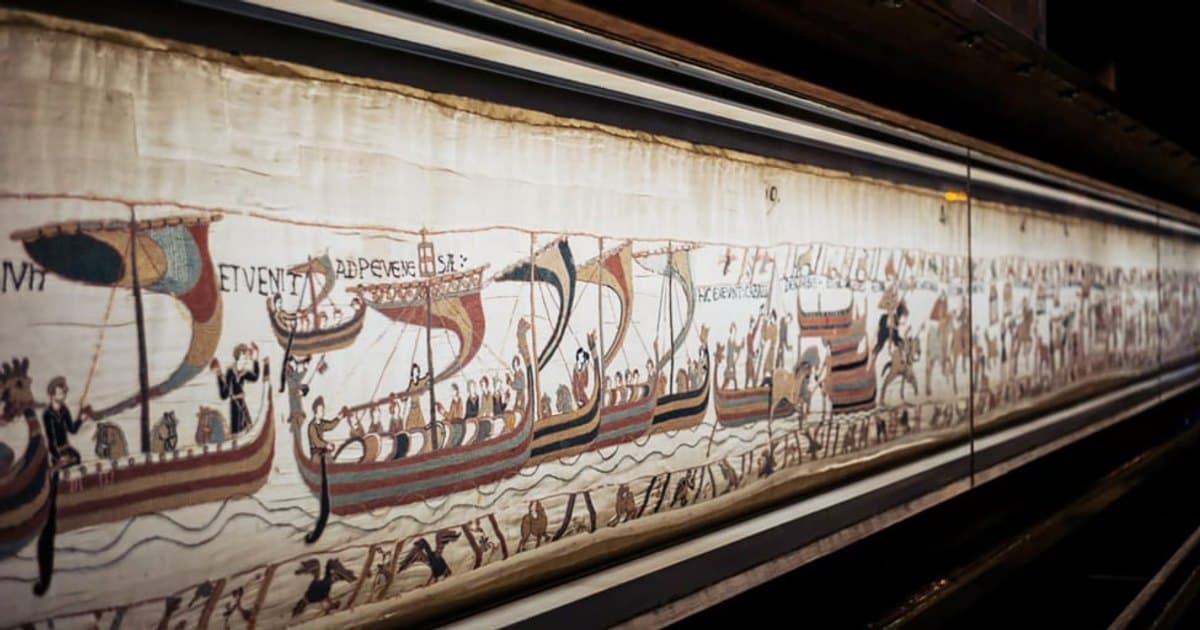
Bayeux Tapestry Returns to England After 1,000 Years
The Bayeux Tapestry, a 70-metre embroidery of the Norman conquest, is displayed in London for the first time since 1066.
After nearly a millennium, the Bayeux Tapestry has returned to English soil. The 70-metre embroidered narrative of the Norman conquest of 1066 is now on public display at the British Museum in London, drawing sold-out crowds and expected to attract one million visitors before the exhibition closes in July 2027.
The tapestry, which is more accurately a massive embroidery, tells the story of the last successful invasion of England. It begins with Harold Godwinson's journey to France and his oath to William, Duke of Normandy, and ends with the Battle of Hastings, where Harold was killed and William became king. The work is considered a pivotal record of European history, marking the moment when French language and settlers transformed English society.
Curator Michael Lewis noted at a preview that the tapestry carries a deliberate political message, designed to persuade the English to accept Norman rule after Harold's defeat. The scenes are vivid and often brutal, showing archers, cavalry, and hand-to-hand combat, alongside domestic details like soldiers cooking meals and burning houses. The margins are filled with fantastical creatures and everyday objects, sometimes offering ironic commentary.
Historians value the tapestry as a rare window into 11th-century life, from shipbuilding and armour to astronomy—Halley's Comet appears in one scene. Scholars still debate details, including the number of depicted male figures and whether the arrow in Harold's eye was added later. A final scene, possibly showing William's coronation, is missing.
The tapestry was likely commissioned by Bishop Odo of Bayeux, William's half-brother, and was probably stitched by women in southeast England. It has spent nearly 1,000 years in France, and its loan to Britain required years of diplomacy, delayed by COVID-19 and Brexit tensions. It is insured for €960 million and travelled in climate-controlled packaging under police escort.
Displayed flat in a state-of-the-art case, the tapestry will eventually return to France. Curators say the journey has provided valuable knowledge for its safe transport back.