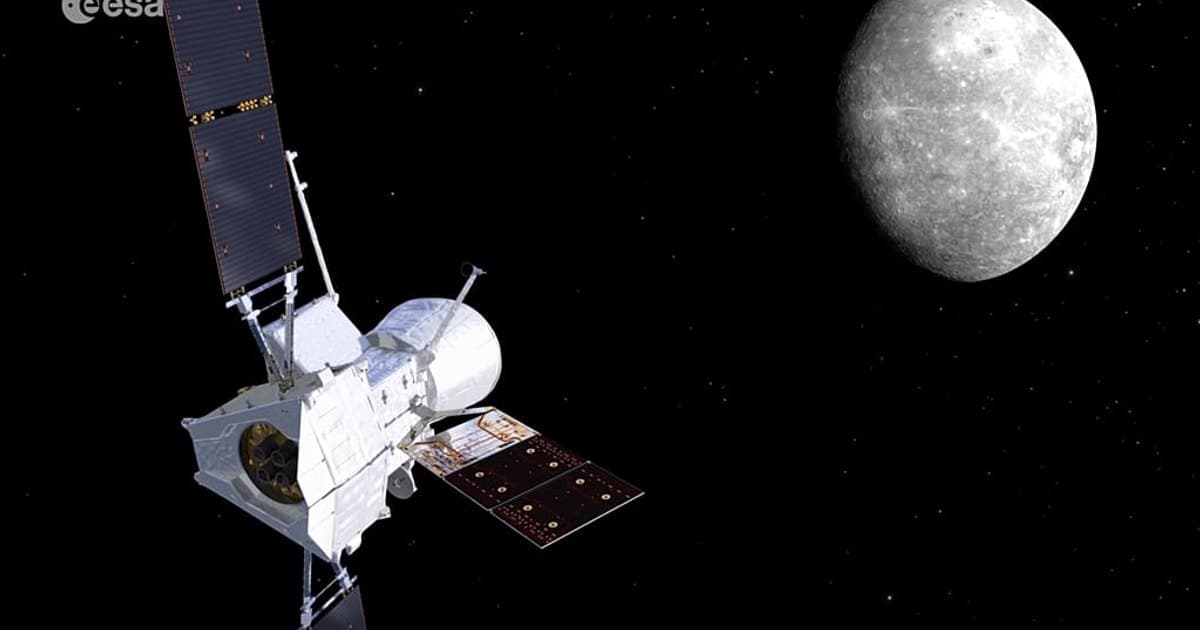
BepiColombo spacecraft on final approach to Mercury after decade-long journey
BepiColombo's twin probes separated from their carrier and are on course for Mercury orbit insertion in November, ending a decade-long voyage.
The two spacecraft of the BepiColombo mission have begun their final descent toward Mercury after separating from their cruise module on Thursday. The separation, which occurred as planned, was confirmed by controllers at the European Space Agency's operations centre in Germany after a tense two-hour wait for radio signals from more than 200 million kilometres away.
"It's a brilliant moment," said lead project scientist Geraint Jones.
The joint European-Japanese mission, launched in 2018, has travelled over 10 billion kilometres on a circuitous route that included nine planetary flybys to shed enough energy for capture by Mercury's gravity. The final flyby in January 2025 returned striking images of the planet's cratered surface and volcanic plains.
If the remaining trajectory holds, the conjoined spacecraft will enter orbit around Mercury in November and separate into two independent probes in December. The European and Japanese orbiters will then map and study the planet from different altitudes, with science operations beginning next spring.
Mercury, only slightly larger than Earth's moon, remains one of the solar system's most enigmatic worlds. "How tiny Mercury is and still it holds some of the biggest mysteries of our solar system," said mission manager Santa Martinez. Jones echoed the sentiment: "There's a huge amount still left to be learned."
Instruments aboard both spacecraft will investigate Mercury's magnetic field, its dense interior, and surface geology, including mysterious hollows believed to form as minerals vaporise from rocks. The planet presents extreme contrasts: surface temperatures can exceed 427 degrees Celsius, while permanently shadowed polar craters harbour ice.
Engineers designed the mission to endure punishing thermal conditions. "It's essentially equivalent to operating with a very hot pizza oven running right on your back," said Ignacio Tanco, a mission operations chief at the European Space Agency.
The mission is named after Giuseppe Colombo, the Italian mathematician who contributed to NASA's Mariner 10 Mercury flybys in the 1970s. Only NASA's Messenger spacecraft has previously orbited Mercury. The European Space Agency is funding most of the mission's approximately €1.7 billion cost.