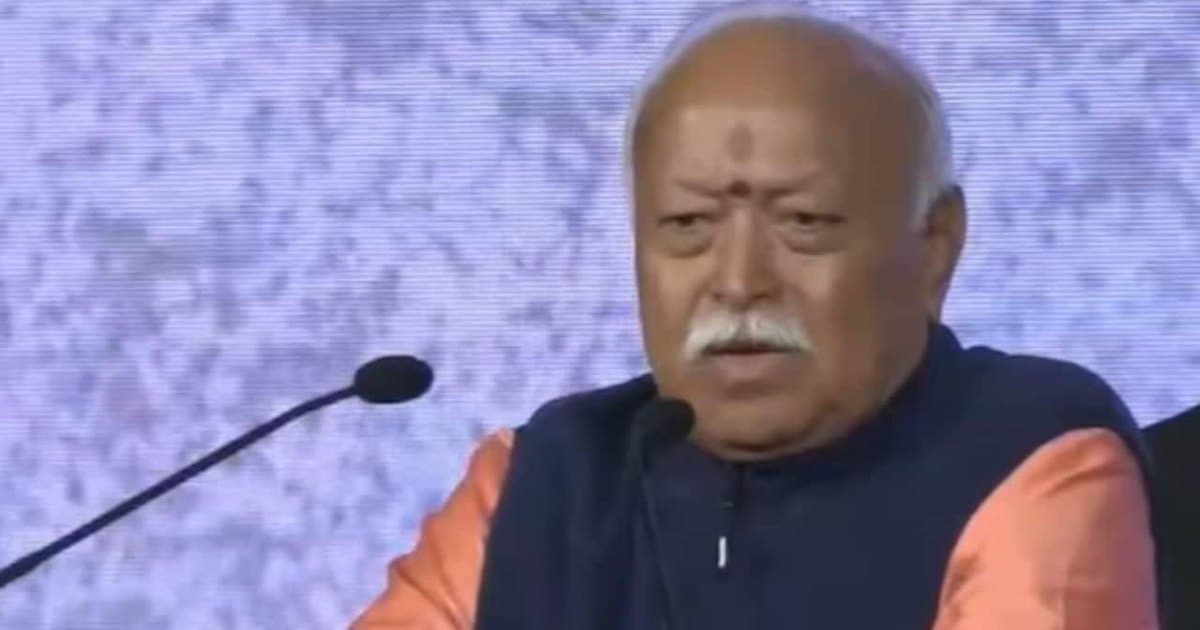
RSS chief Bhagwat tells New York audience Bharat's destiny is to show unity in diversity
RSS chief Mohan Bhagwat, addressing a diaspora event in New York, said Bharat's mission is to teach the world that unity and diversity can coexist.
Rashtriya Swayamsevak Sangh (RSS) chief Mohan Bhagwat said on Saturday that Bharat's "destiny" is to help the world understand that unity and diversity are not contradictory, and that India must prove this "not by preaching, but by practice."
Speaking to an audience of about 5,000 people at New York's Madison Square Garden, Bhagwat invoked Swami Vivekananda to argue that every nation has a duty, a message, and a mission. For Bharat, he said, that mission is to demonstrate the idea of unity underlying diversity.
"For Bharat, this unity and diversity are part of the DNA," he said. "Diversity has to be celebrated, has to be respected, has to be accepted. And at the same time, we must keep in mind this feeling of oneness."
The event, organised by the AHEAD Forum as part of the RSS's centenary-year global outreach, took place amid controversy. New York Mayor Zohran Mamdani had earlier said he did not support the event, calling it part of a movement based on an "exclusionary vision" and questioning its compatibility with the pluralistic India he grew up with. He added that he did not know if the city had jurisdiction to cancel a private event.
Interfaith and civil rights groups, including Hindus for Human Rights, the Indian American Muslim Council, and the Interfaith Centre of New York, held a press conference outside City Hall urging the cancellation of the programme.
In his address, Bhagwat elaborated on the RSS's vision of India's civilisational role. He said the idea of oneness is not merely philosophical but has practical implications. He asked the audience to imagine eating while a hungry person watches, saying a human being would instinctively find it difficult to continue.
He contrasted two approaches: "live and let live" and "live and let those live who obey us." Those who protect only the obedient are "rakshasas," he said, while those who care for others regardless of utility represent the "devas."
Bhagwat said India's civilisational understanding sees humanity as connected through the atman, like beads on a single thread. Differences of body, clothing, and worship do not alter this underlying unity. "You appear different but you are not," he said. "Your body will die, but something lives permanently. We belong to each other."
He said India's ancestors organised the people "south of Himalayas up to the sea" into a nation with the task of sharing this knowledge with the world. "That is the mission Bharat has to accomplish. Not by preaching, but by practice."
Addressing the Indian diaspora, Bhagwat said their first responsibility is towards the United States, their "karmabhoomi." He urged them to live by Indian values and to give back to the world. "How much we earn is not important. How much we distribute is," he said.
He also touched on humanity's relationship with nature, citing historian Yuval Noah Harari's Sapiens to note that humans' rise to the top of the food chain has come at the cost of other species. "We cannot merely let live. We have to help others live," he said.
Bhagwat said India's tradition does not call for the destruction of enemies. Instead, the appropriate response to wickedness is to wish that the "wicked mindset" goes away, not the person. "Even our enemies and we are one," he said, describing enmity as a "man made thing" arising from circumstances.