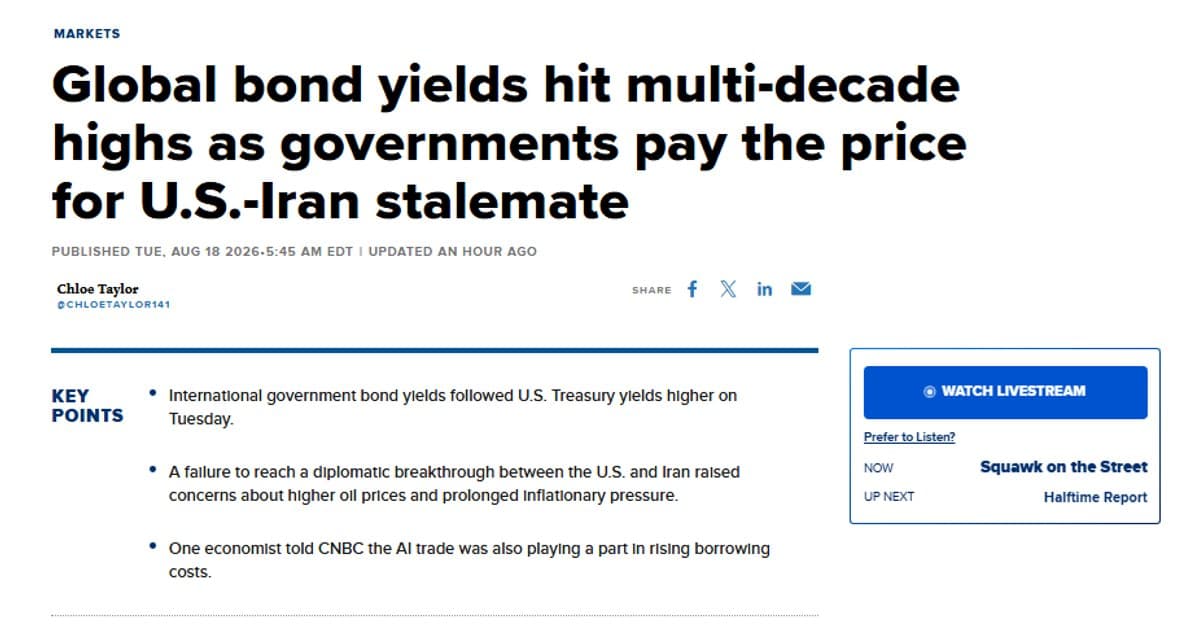
Bond Yields Hit Multi-Year Highs as Iran-US Tensions Resurge
Renewed Iran-US strikes push oil above $95 and US 10-year yield to near 3-year high, as Japan's rate hike signals add to bond market pressure.
Global bond markets came under renewed pressure on Wednesday as the United States and Iran resumed direct hostilities, sending oil prices higher and pushing key government bond yields to fresh multi-year milestones.
Brent crude climbed above $95 a barrel after the Pentagon confirmed a fresh wave of strikes against Islamic Revolutionary Guard Corps targets. Tehran said it had responded by attacking US assets in Jordan and Iraq. The exchange marks the first serious military confrontation between the two countries since July.
The escalation drove the yield on the US 10-year Treasury note to an intraday high of 4.8122%, its strongest level in nearly three years. Japan's 10-year government bond yield also extended its recent surge, touching levels not seen in three decades.
For fixed-income investors, the conflict adds another layer of difficulty on top of existing concerns over large fiscal deficits. Bond vigilantes have already been demanding higher compensation to fund government borrowing, and a renewed oil shock threatens to stoke inflation further, eroding the appeal of debt instruments.
Adding to the pressure were signals from the Bank of Japan. Governor Kazuo Ueda reiterated his commitment to continue raising interest rates, while board member Hajime Takata, known for his hawkish stance, called for a faster pace of monetary tightening. Higher yields in Japan could encourage domestic investors to keep money at home, reducing a key source of demand for overseas bonds.
Elsewhere, the Reserve Bank of New Zealand delivered a widely expected 25-basis-point rate hike but paired it with a more dovish statement, sending the New Zealand dollar down 1% to $0.58375.
Equity markets reflected the tighter financial conditions. MSCI's broadest index of Asia-Pacific shares outside Japan fell 1.7%, with South Korea's KOSPI dropping more than 3.5%. Japan's Nikkei 225 slid 2.7%, while S&P 500 e-mini futures edged 0.1% lower. In Europe, pan-region futures were down 0.4%, with German DAX and FTSE futures both 0.5% lower.