CityUHK Study Decodes Brain's Multitasking Ability, Finds Neural Reorganisation
A CityUHK-led study uncovers how the brain reorganises neural activity to enable efficient multitasking, with implications for AI and rehabilitation.
A new study co-led by Professor Yung Wing-ho of City University of Hong Kong (CityUHK) and researchers from The Chinese University of Hong Kong has revealed the cellular mechanisms that allow the brain to handle multiple tasks simultaneously. Published in the journal Neuron, the findings overturn the common belief that multitasking is inherently inefficient, showing instead that the brain dynamically reorganises itself to break through cognitive bottlenecks.
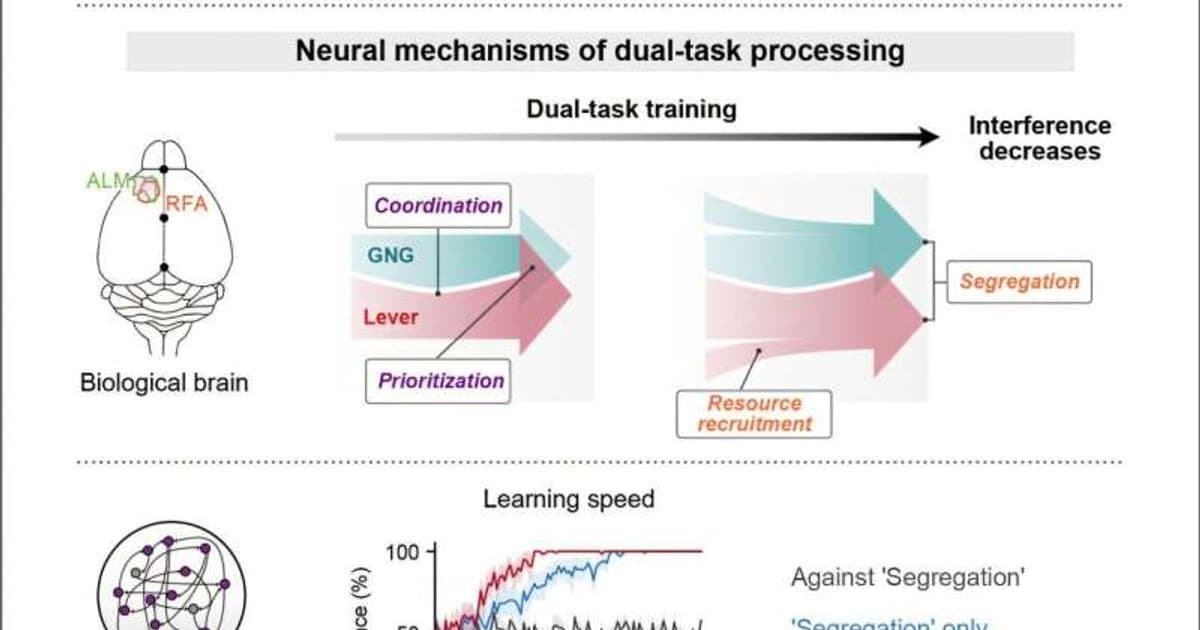
The team used a mouse model where animals performed a continuous lever-pressing task while responding to auditory cues in a Go/No-Go test. By tracking individual neurons in the secondary motor cortex (M2) over weeks of training with two-photon calcium imaging, they observed how neural activity evolved as the mice learned to multitask.
Initially, neurons involved in both tasks competed for resources, causing interference. Even neurons dedicated to one task adjusted their firing when the other task was processed, helping early coordination. With continued practice, the brain recruited more task-specific neurons and gradually separated the neural representations of the two tasks, reducing interference and improving performance.
The study also showed that M2 is causally important: when its activity was moderately suppressed during training, mice failed to improve, but once suppression was removed, performance rapidly recovered.
Computer simulations using recurrent neural networks confirmed that a strategy of early coordination followed by progressive separation was more effective than immediate separation. This mirrors the biological findings and offers a blueprint for designing AI systems that can manage competing tasks efficiently.
Professor Yung noted that efficient multitasking requires a balance between coordination and specialisation, which could inform understanding of multitasking deficits in neurological disorders and guide AI development. The team plans to apply these insights to optimise learning strategies in education and improve rehabilitation programmes for neurological conditions.