BRICS Adopts New Delhi Declaration, Flags Middle East Tensions and Unilateral Sanctions
BRICS leaders at the New Delhi summit adopted a joint declaration expressing concern over Middle East tensions and condemning sanctions not authorised by the UN.
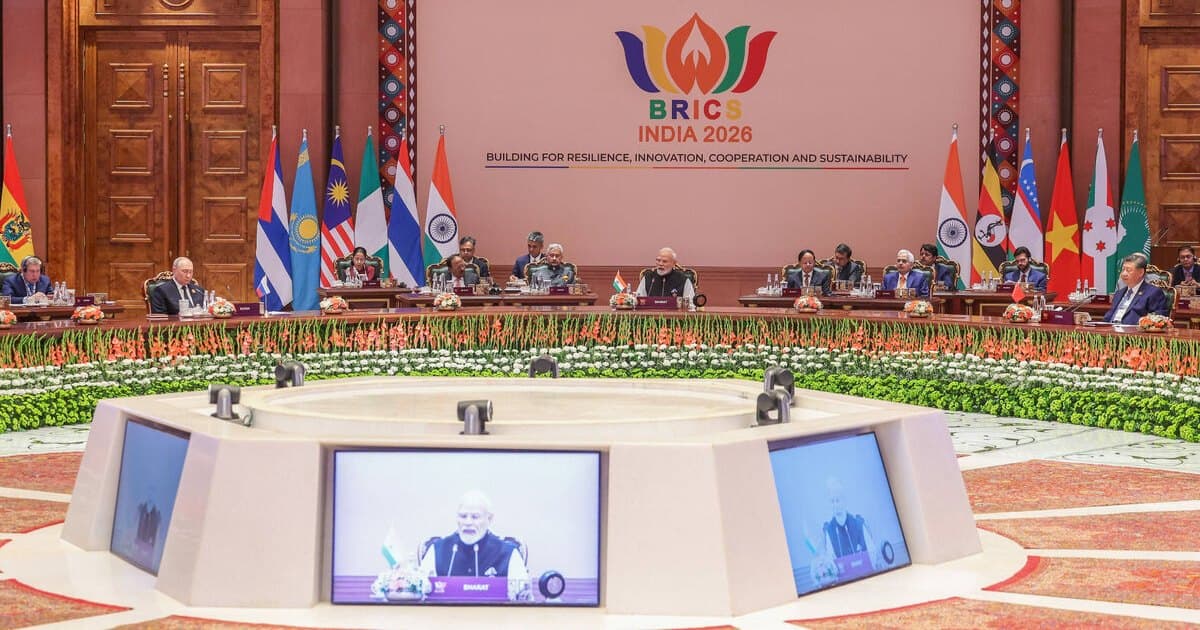
Leaders of the BRICS group of emerging economies adopted the New Delhi Declaration by consensus on Saturday, expressing concern over escalating tensions in the Middle East and rejecting sanctions imposed without United Nations authorisation.
The declaration, agreed at a summit hosted by India, voiced worry over what it described as deliberate attacks on civilian infrastructure and on peaceful nuclear facilities operating under the safeguards of the UN's atomic energy agency. It said nuclear safety and security must be protected during armed conflicts — language widely read as indirect criticism of strikes on Iranian nuclear sites.
The leaders also targeted coercive economic measures that fall outside the UN Security Council's mandate. Without naming any country, the joint statement called for the elimination of such unlawful measures, saying they undermine international law and the principles and purposes of the UN Charter. Russia, a founding member of the bloc, has faced Western sanctions since its invasion of Ukraine in 2022.
Addressing the gathering, Prime Minister Narendra Modi said the declaration offered a clear direction to the group's shared resolve and that it was now the leaders' responsibility to turn those resolutions into concrete outcomes. He added that the changing world could not be managed with old institutions, and that representation, responsiveness and rule-making all required improvement.
Modi's remarks appeared aimed at easing concerns that BRICS is designed to counter Western-led alliances, casting it instead as a platform for emerging and developing economies to secure a stronger voice in global affairs.
Russian President Vladimir Putin, Chinese President Xi Jinping and Iranian President Masoud Pezeshkian were among those attending, along with counterparts from the bloc's other members. Putin called for expanding the UN Security Council to give greater representation to Asia, Africa and Latin America, arguing it would make the body more effective. Iran has pushed for mechanisms that reduce reliance on Western financial systems and shield members from economic pressure.
China is using the grouping to deepen its influence and present it as a counterweight to US power. A Chinese Foreign Ministry spokesperson said ahead of the summit that Xi was expected to discuss major international issues and ways to deepen cooperation among members.
For India, the meeting highlights its effort to sustain strategic ties with Russia and Iran while expanding economic, defence and technology links with the United States and Europe. New Delhi has called for dialogue and diplomacy to resolve conflicts, and Modi met Putin and Pezeshkian separately on Friday. He and Xi were expected to hold talks later on Saturday, a meeting that could consolidate a diplomatic thaw after border tensions escalated in 2020.
Founded in 2006 by Brazil, Russia, India and China, with South Africa joining in 2010, BRICS has since expanded to 11 members representing roughly half the world's population and a substantial share of global output. The bloc has increasingly sought greater representation for developing countries and promoted alternatives to Western-dominated financial institutions.
Its ability to find common ground is being tested by the wars in Ukraine and the Middle East and by rising US-China tensions. In May, BRICS foreign ministers failed to agree on a joint statement over the Iran war, forcing India to issue a chair's summary instead.