Canada's economy rebounds in Q2 as exports and domestic spending pick up
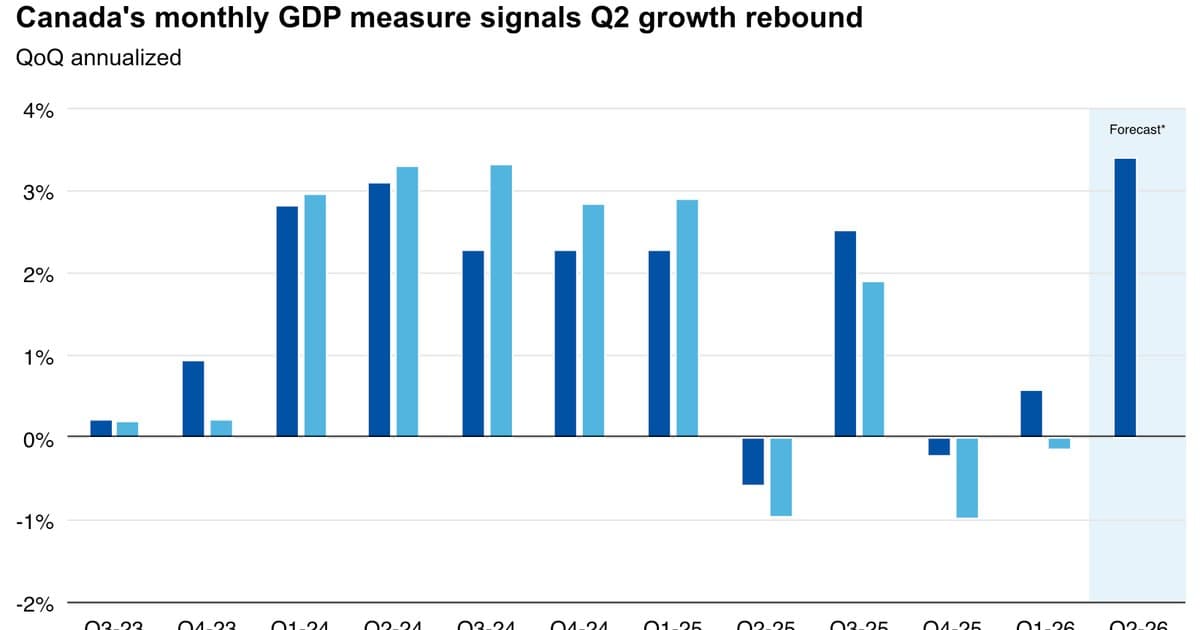
Canada's GDP grew at an annualized 3.3% in Q2, driven by a surge in exports and stronger household and business spending.
Canada's economy posted a sharp rebound in the second quarter, growing at an annualized rate of 3.3%, according to data released Friday by Statistics Canada. The figure marks a significant acceleration from the upwardly revised 0.3% growth recorded in the first three months of the year.
The latest reading means Canada did not slip into a technical recession, which is typically defined as two consecutive quarters of contraction. The first-quarter figure was previously reported as a slight decline, but the revision erased that concern.
A key driver of the growth was a 3.6% jump in exports, the fastest pace in over three years. Domestic demand also strengthened, with final domestic demand rising 1% in the quarter after a small contraction in Q1. Household spending climbed 0.8%, the strongest showing in three quarters, while business investment expanded 2.3% — the first increase in a year and a half — led by gains in residential and non-residential structures, as well as machinery and equipment.
The rebound signals that the economy is gradually shaking off the drag from more than 18 months of U.S. tariffs that disrupted supply chains and raised costs. Strong domestic consumption and investment are also seen as providing a buffer against the latest round of U.S. tariffs, including a new 50% duty imposed this week, to which Canada has responded with counter-measures.
The quarterly growth outpaced the Bank of Canada's July forecast of 2.5% annualized expansion. On a quarter-over-quarter basis, GDP rose 0.8% in the April-to-June period, up from a revised 0.1% in Q1.
Government investment in fixed assets continued to decline, contracting 2.9% in Q2 after a 2.6% drop in the previous quarter.
On a monthly basis, GDP grew 0.3% in June, slightly above expectations of 0.2%. Advance data suggests the economy was largely flat in July.