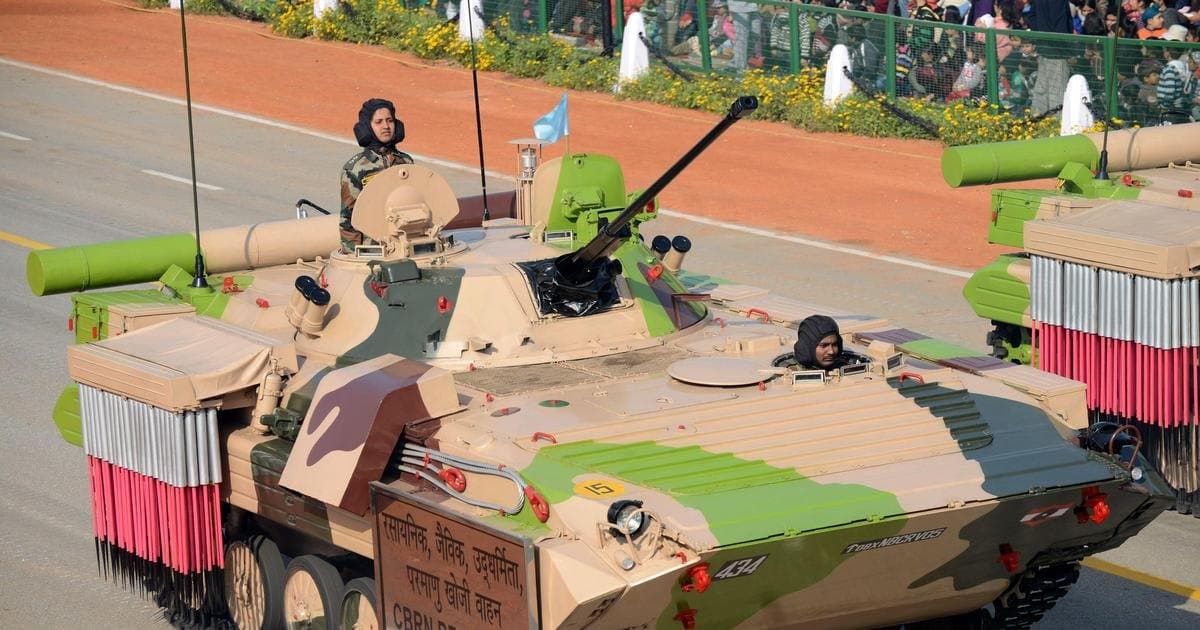
Explained: The CBRN reconnaissance vehicles the Indian Army plans to buy
India's DAC has approved the acquisition of CBRN reconnaissance vehicles for the Army, boosting its capability to operate in contaminated zones.
The Defence Acquisition Council (DAC), chaired by Defence Minister Rajnath Singh, has given its Acceptance of Necessity (AoN) to capital acquisition proposals estimated at roughly ₹1.10 lakh crore. This includes the procurement of Chemical, Biological, Radiological and Nuclear (CBRN) reconnaissance vehicles for the Indian Army.
The move reflects the increasing importance of specialised platforms that can function in environments contaminated by hazardous agents. These systems are designed to detect threats and map affected areas while minimising troop exposure.
What are CBRN reconnaissance vehicles?
CBRN reconnaissance vehicles are specialised military platforms fitted with sensors and detection equipment to identify and assess areas contaminated by chemical, biological, radiological or nuclear agents. Their role is not to counter the source of contamination but to detect, monitor, and mark affected zones, relaying this information to operational formations.
In conventional warfare, a CBRN hazard can severely restrict the movement of troops and equipment. These vehicles give commanders crucial data on the location and extent of contamination, enabling safer route planning and deployment.
The CBRN Reconnaissance Vehicle (Tracked) Mk-II
One system linked to the Army's requirement is the CBRN Reconnaissance Vehicle (Tracked) Mk-II. Built on the BMP-II infantry combat vehicle platform, it has been re-engineered to house the necessary reconnaissance equipment. The tracked platform is intended for operations in plains, desert, and semi-desert terrain. It can enter or operate near contaminated zones to gather information without exposing personnel unnecessarily.
The vehicle can detect and identify CBRN agents, monitor contaminated areas, and mark such zones. The data collected is transmitted to supported formations, giving commanders a clearer picture of the threat. Its tracked design provides the mobility needed to accompany military formations during operations.
Why are these vehicles important?
CBRN contamination is often difficult to detect through conventional means. Chemical or biological agents may be invisible, and radiological contamination requires specialised equipment to identify. A dedicated reconnaissance vehicle acts as an early-warning and battlefield assessment platform.
Its importance grows in high-intensity conflicts where the deliberate or accidental release of hazardous agents could affect troop concentrations, supply routes, or installations. By identifying and marking contaminated zones, these units help prevent troops from inadvertently entering dangerous areas and provide data for decontamination efforts.
Unmanned systems and domestic manufacturing
The Army is also exploring unmanned technology for CBRN reconnaissance. The CBRN Mini UGV (unmanned ground vehicle) is designed for detection, sample collection, and marking of contaminated zones without risking personnel. Being tele-operated gives these systems a key advantage in high-risk environments.
The acquisition comes as the Defence Research and Development Organisation (DRDO) transfers production rights for several systems to Indian companies. The Vehicles Research & Development Establishment (VRDE), a DRDO lab, has transferred technology for the CBRN Reconnaissance Vehicle (Tracked) Mk-II to Bharat Electronics Limited (BEL). This supports the wider push for domestic defence manufacturing.
The combination of procurement and technology transfer signals an effort to build domestic capability in this niche area. The planned acquisition of both manned and unmanned CBRN reconnaissance systems points to a layered approach, where the two can operate together to provide comprehensive situational awareness.