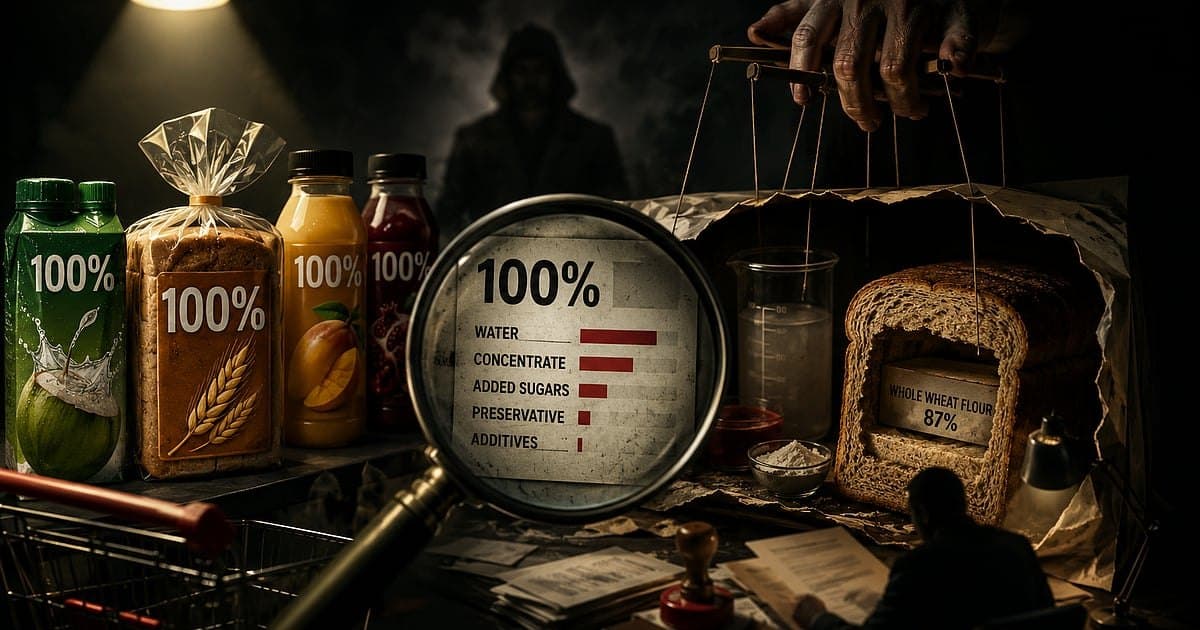
CCPA's '100%' crackdown: When food labels promise more than they deliver
India's consumer watchdog is penalising food firms for '100%' label claims that don't match actual ingredients, setting new rules for packaging honesty.
The Central Consumer Protection Authority (CCPA) has intensified its scrutiny of food products that carry absolute claims such as "100%" on their labels, warning that such wording can mislead buyers into believing the item is entirely composed of a single ingredient or is of unmatched purity.
This regulatory push comes alongside a similar advisory from the Food Safety and Standards Authority of India (FSSAI), which has asked food businesses to drop the term from packaging and promotional materials, noting that the expression lacks a clear legal definition and can create a false impression of superiority.
Penalties and findings
In June 2026, the CCPA imposed a fine of ₹1 lakh each on Mrs. Bectors Food Specialities (which sells English Oven products) and Storia Foods and Beverages. Both were ordered to remove the contested claims from their packaging and digital platforms.
In the first case, a bread product was marketed as "100% Atta Bread" and "100% Whole Wheat Bread," yet the company admitted that whole wheat flour constituted only 87% of the recipe. The firm argued that "100% Atta" was intended to signal that wheat was the sole grain used. The CCPA rejected this defence, stating that "100%" is an exact numerical term and cannot be used loosely. It also noted that the accompanying "Zero Maida" tag reinforced the impression that the bread was made entirely from whole wheat.
Juice and beverage claims
A similar issue arose with Storia's "100% Tender Coconut Water" product. The ingredient list revealed that the drink was primarily water mixed with 9.6% coconut water concentrate, with a note saying it was "Equivalent to 100% Coconut Water" and "Reconstituted." The CCPA held that the prominent front-of-pack claim would lead an ordinary consumer to believe the bottle contained pure, natural coconut water.
The regulator also examined Storia's fruit beverages labelled "100% Juice." For instance, the pomegranate variant contained water, 4% pomegranate concentrate, and 10% apple concentrate, while the mango version had water, 16% mango pulp, and 12.5% apple concentrate.
Fine print is not a shield
The CCPA's orders clarify that a detailed ingredient declaration on the back of a packet does not automatically correct a misleading headline claim. Since consumers often glance at the front label first, the authority evaluates the overall impression created by the packaging.
This principle was applied in the case of McVitie's Wholewheat Marie biscuits, which contained only 19.5% whole wheat flour against 52% refined wheat flour. The prominent "Wholewheat" branding and wheat imagery were deemed likely to mislead. The manufacturer, Pladis India, argued that the term was a registered trademark and pointed to a disclaimer. The CCPA responded that trademark status does not exempt a company from consumer-protection laws, nor does a disclaimer necessarily neutralise a misleading representation.
Regulatory framework
The FSSAI had earlier, in June 2024, specifically directed businesses to remove "100% Fruit Juice" claims from reconstituted products. While the FSSAI focuses on food safety and labelling standards, the CCPA operates under the Consumer Protection Act. Under Section 21 of that law, the CCPA can order the discontinuation of false advertisements and impose penalties of up to ₹10 lakh for a first offence, rising to ₹50 lakh for subsequent violations.
Implications for industry and buyers
The recent actions signal that regulators will examine not just the ingredient list but also product names, imagery, and disclaimers when assessing whether a claim is deceptive. For consumers, the lesson is that front-of-pack messaging may not always reflect the full contents, making the ingredient list an essential reference point.