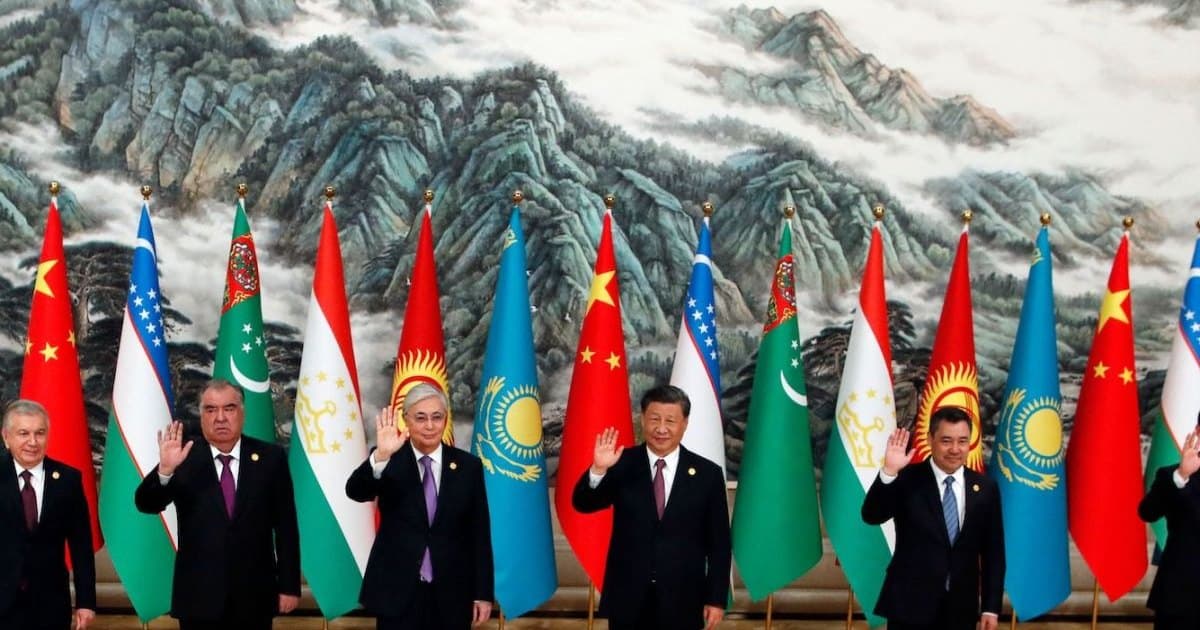
Central Asia's Quiet Realignment: China Rises as Russia's Grip Loosens
China is eclipsing Russia economically in Central Asia, but Moscow retains security influence as regional states pursue multi-vector policies to preserve autonomy.
The five Central Asian republics — Kazakhstan, Kyrgyzstan, Tajikistan, Turkmenistan, and Uzbekistan — are at the centre of a significant geopolitical shift. The region, long shaped by Russian dominance, is now witnessing a redistribution of influence as China's economic weight grows. This is not a simple transfer of power, but a complex recalibration where Moscow retains security and cultural leverage while Beijing increasingly dominates trade, infrastructure, and investment.
Russia's historical influence in the region is deep-rooted, stemming from imperial expansion and Soviet-era integration. Railways, pipelines, and power grids were built to connect northwards to Russia, and Russian became the common language of administration and education. Even after independence in 1991, Moscow remained the principal external actor through security pacts, arms supplies, and labour migration ties.
China's engagement, accelerated by the Belt and Road Initiative launched in Kazakhstan in 2013, has fundamentally altered this equation. Beijing's strategy is built on trade, energy, and infrastructure rather than security networks. Chinese trade with the region now significantly exceeds Russia's, and Chinese companies are active in oil, gas, mining, and manufacturing. Major projects like the China-Central Asia gas pipeline and the planned China-Kyrgyzstan-Uzbekistan railway are reshaping the region's economic geography, creating east-west links that bypass Russia.
Russia's position has weakened, particularly after the Ukraine war exposed its economic and military limits. Western sanctions have complicated trade routes, and Moscow's image as an unassailable security guarantor has been dented. Yet Russia remains relevant through military infrastructure, cultural ties, and the continued dependence on Soviet-era equipment.
Crucially, the Central Asian states are not passive observers. They are actively pursuing multi-vector foreign policies, engaging with Turkey, the EU, Gulf states, and India to diversify their partnerships. While Chinese capital is welcome, there is awareness of the risks of over-dependence, prompting interest in alternative corridors like the Middle Corridor across the Caspian Sea. The underlying goal for these governments is autonomy through diversification, navigating between Beijing's economic pull and Moscow's residual strategic presence.