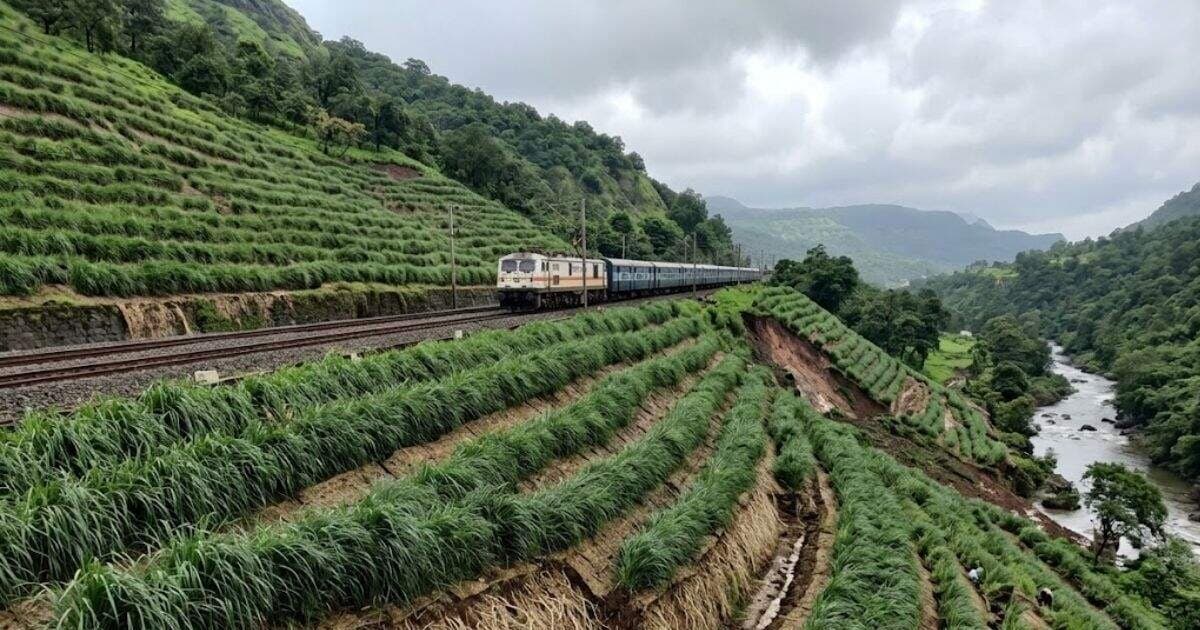
Central Railway turns to vetiver grass to secure monsoon-prone ghat tracks
Central Railway will use vetiver grass on ghat slopes to prevent soil erosion, landslips and boulder falls during monsoon, ensuring safer train operations.
To keep train services running safely through the Western Ghats during the monsoon, the Central Railway is turning to a nature-based solution: large-scale plantation of vetiver grass. The move is aimed at preventing soil erosion, surface runoff and shallow landslips that frequently disrupt rail traffic on the ghat sections.
The railway has identified the Bhor Ghat (Karjat-Lonavala) and Thal Ghat (Kasara-Igatpuri) as particularly vulnerable stretches. During heavy rains, these areas face boulder falls and slope failures that pose a serious risk to train operations.
Vetiver grass, scientifically known as Chrysopogon zizanioides, is recognised globally as a high-performance bioengineering tool for slope stabilisation. Its dense, fibrous root system grows vertically to depths of 3 to 4 metres within 12 to 24 months. This natural reinforcement binds the soil and increases its shear resistance by an estimated 30 to 40 percent, significantly lowering the chances of slumping and shallow slope failure.
The grass also acts as a porous barrier above ground. Its thick foliage slows down surface runoff, prevents gully formation, improves water infiltration and traps silt. Over time, the accumulated sediment helps form natural terraces, further strengthening the slopes.
Pilot plantations have already been carried out on the South-East Ghat section. These include the Khandala–Monkey Hill stretch, covering about 1,050 square metres, and the Thakurwadi Cabin–Palasdhari section, where the plantation spans roughly 4,250 square metres.
For railway use, vetiver hedges are being planted along contour lines on cutting slopes and embankments. Officials say this approach will reduce instances of boulders and debris falling onto tracks, ensure safer and more punctual train services during the monsoon, and cut down on the maintenance costs associated with conventional protection structures.