China's bond yields defy global rout, but for troubling reasons
China's 10-year bond yield falls below 1.7% even as global yields spike, driven by deflation, capital controls, and a savings glut.
Global sovereign bond markets are under pressure as investors demand higher yields to compensate for inflation, policy uncertainty, and rising debt. Yet China stands apart: the yield on its benchmark 10-year government bond has slipped below 1.7%, more than 300 basis points lower than the comparable U.S. Treasury yield. That gap is the widest since early last year and could soon become the largest on record.
For over a decade until 2022, Chinese government bond yields actually exceeded those of U.S. Treasuries. The reversal is largely a story of inflation—or the lack of it. While much of the world battles elevated price pressures, China continues to fight deflation, a legacy of the property crash that began in 2021. Weak consumption and economic activity have kept consumer price inflation subdued.
There are tentative signs of improvement: annual producer price inflation turned positive earlier this year, reaching over 4% in June, and the GDP deflator also moved into positive territory in the second quarter. But these signals have not yet translated into higher bond yields.
China's official government debt-to-GDP ratio is projected at 75% this year—lower than most G7 peers except Germany. However, that figure masks a more complex picture. The IMF's broader "augmented debt" measure, which includes off-balance-sheet borrowings such as local government financing vehicles, is expected to reach 136% of GDP this year and exceed 150% by the end of the decade—levels closer to the U.S. and Italy.
Analysts at Barclays argue that, based on fiscal fundamentals alone, China's bond yields should be higher than the West's. They point to a deteriorating balance sheet, a collapsing property market that has eroded local government revenue, and significant off-balance-sheet liabilities—hardly the profile of a borrower at 1.70%.
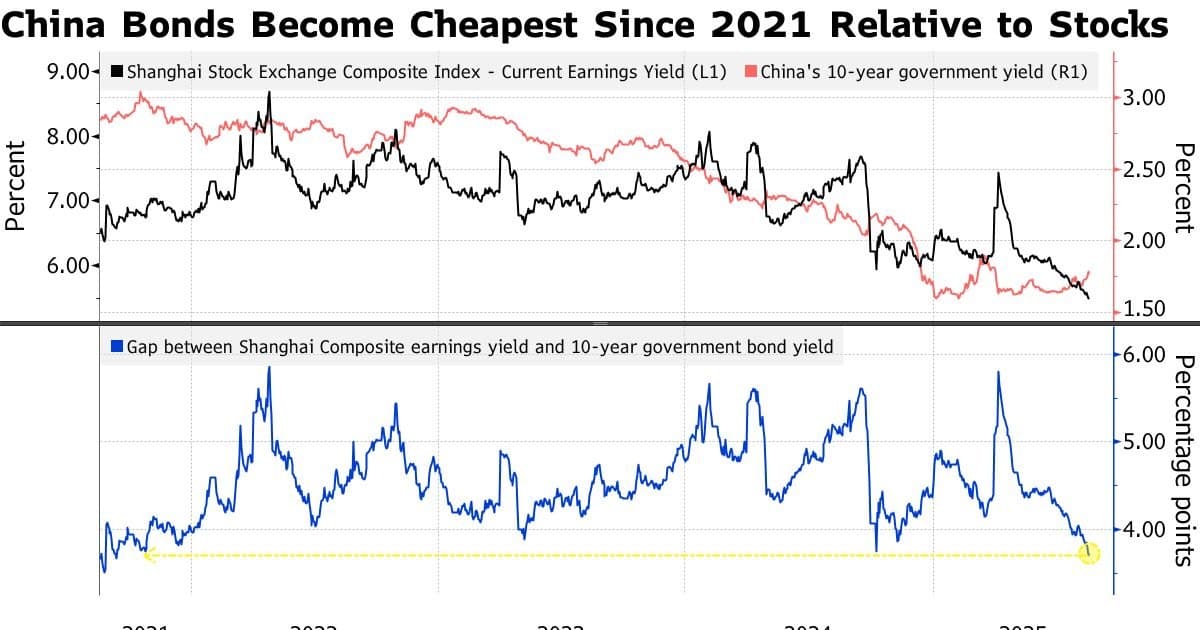
So why are yields so low? The answer lies in China's domestic dynamics: a massive pool of household savings, strict capital controls that keep those savings at home, and a scarcity of safe investment alternatives. China's gross domestic savings rate is 43% of GDP—more than double that of the U.S. With property no longer a reliable store of value and equities still volatile—the CSI 300 index remains 20% below its 2021 peak—many households continue to buy government bonds despite meager returns.
HSBC analysts expect the 10-year yield to fall as low as 1.50% later this year, driven by sustained demand. But this savings glut is also a symptom of China's deflationary pressures. Consumers are not spending enough, and the country's transition from a capital-intensive growth model to one driven by consumption remains incomplete.
While rising developed-market yields may worry investors, China's falling yields are not a sign of fiscal health. They reflect trapped money with few alternatives—a dynamic that underscores deeper economic challenges.