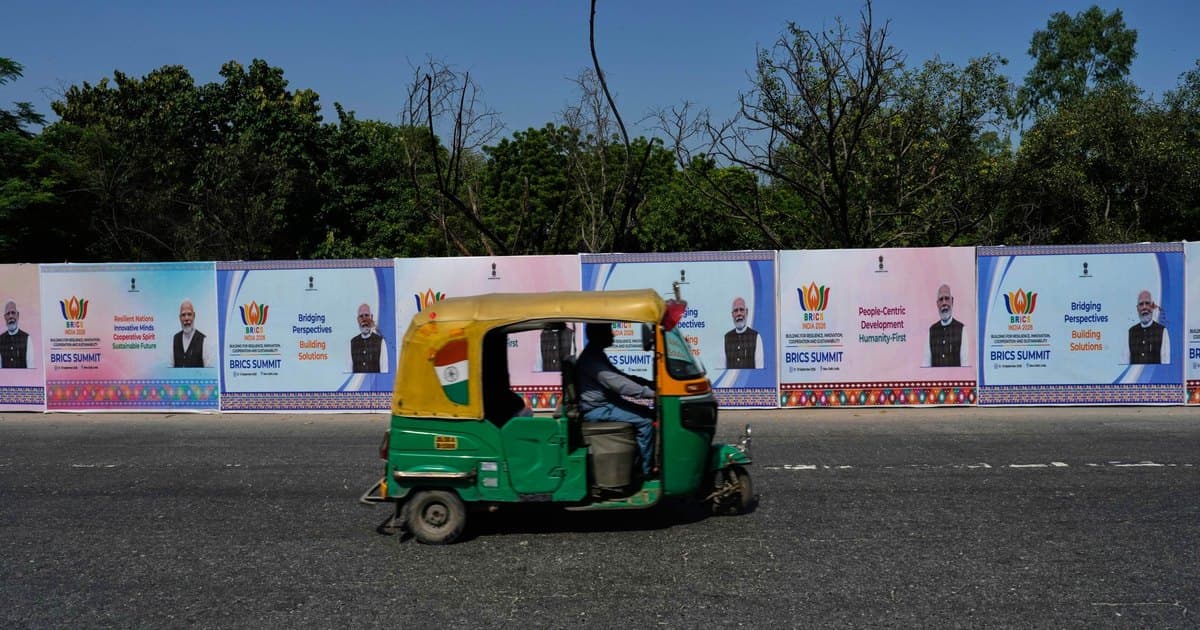
Banners Screen South Delhi Slum as BRICS Summit Gets Underway
A slum settlement along Nelson Mandela Marg and Munirka Marg in south Delhi has been covered with white-purple banners during the BRICS Summit, residents say.
A slum settlement in south Delhi's Vasant Vihar has been draped in white-purple banners while the BRICS Summit is underway in the capital, with residents saying the curtains were put up to keep the area out of sight of visiting foreign dignitaries.
The settlement, known as 'Coolie Camp', sits along Nelson Mandela Marg and Munirka Marg. According to 2012 data from the Delhi Urban Shelter Improvement Board (DUSIB), it houses about 281 households. It lies a few kilometres from the DLF Promenade mall in Vasant Kunj and is hemmed in by markets, parks and government housing.
Residents said the banners went up on the night of September 10, two days before the summit began. Curtains roughly 10 feet high now run along the entire stretch, leaving only two points for entry and exit — a change that residents say has made daily movement difficult.
"This is not the first time this area has been covered like this. Even earlier, in 2023, when the G20 Summit happened, the basti was covered with huge green curtains," said Manoj, a vendor who lives in the area.
The settlement is home largely to sanitation workers. Its lanes are about two feet wide, lined with compact multi-storeyed huts, open drains and shared water taps and washrooms. While the curtains have gone up and the roads have been cleaned, an overflowing garbage bin remains just outside the curtain-wall, with litter scattered around it.
Manoj said the barriers have made it hard to bring carts and vehicles in or out. "We are not taking out our carts as we are afraid the police and MCD officials might seize them. Due to this, income has dropped over the last three days," he said.
Several residents are tenants paying at least ₹3,000–4,000 a month in rent. "Our earnings are anyway less. With movement and income restricted, we have to be careful about our expenses, too," said Shivani, a domestic worker.
Others questioned why the response to poverty was to screen it from view rather than address it. "If the government has a problem with poverty, why isn't anything being done to eradicate it?" asked Golu, a sanitation worker.
Manisha, another resident, put it more bluntly: "Just like we cover garbage, they must have thought of us as garbage, too."
Reena, a sanitation worker, raised the gap between election-time outreach and everyday treatment. "Why do the politicians come to us asking for votes with their hands joined during elections if this is what they think of us — people who need to be hidden so that their pride doesn't get hurt? What happened to 'jahan jhuggi wahin makaan'?" she asked.
She also spoke about the insecurity of living without documents. "Despite having lived here for generations, we are not considered residents. I have no Aadhaar card, no voter card, no other document that can help me establish myself as a resident of Delhi. Tomorrow, if the government decides to demolish the slum, where will I go?" she said.