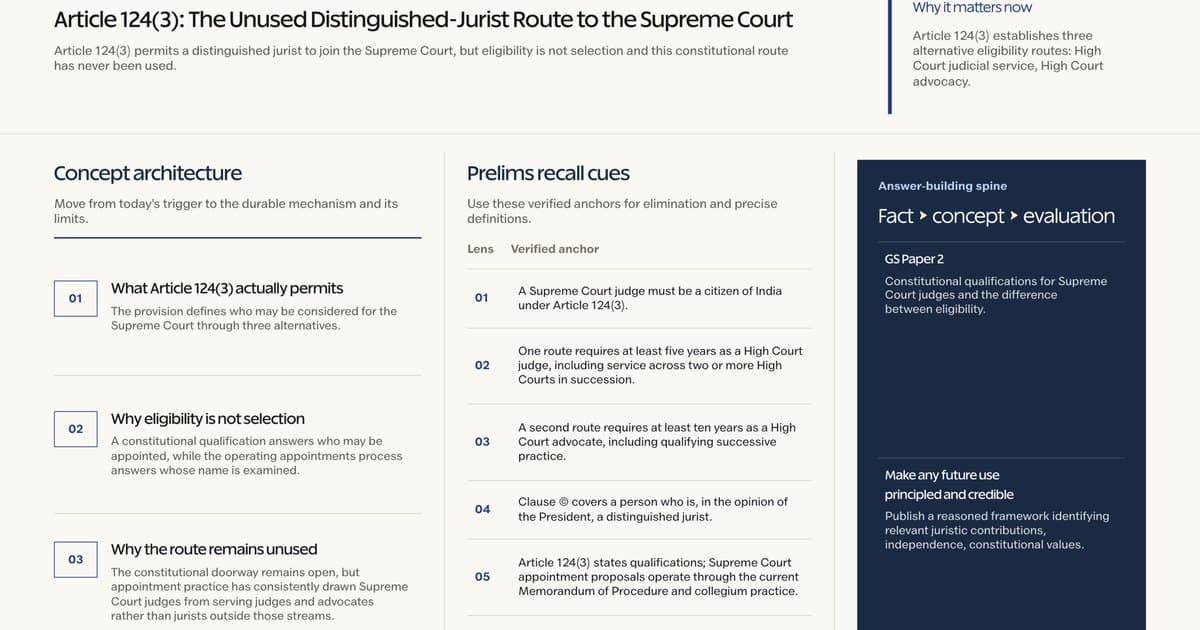
Why has the 'distinguished jurist' route to the Supreme Court never been used?
A Supreme Court judge has questioned why Article 124(3), permitting 'distinguished jurists' to join the apex court, has never been invoked since 1950.
Supreme Court judge Justice Ujjal Bhuyan has raised a pointed question: why has a constitutional provision allowing eminent legal scholars to be appointed to the apex court remained a dead letter for over seven decades?
Speaking at the 13th convocation of National Law University, Delhi's LL.M. programme on August 30, 2026, Justice Bhuyan noted that Article 124(3) of the Constitution permits the appointment of a person who, in the President's opinion, is a "distinguished jurist" as a Supreme Court judge. Yet, no legal academic has ever been elevated under this route.
What does Article 124(3) say?
The provision lays down three pathways to the Supreme Court: five years of service as a High Court judge, ten years of practice as a High Court advocate, or recognition as a "distinguished jurist" in the President's opinion. The Constitution does not define the term or prescribe any minimum experience for such a person, but its inclusion as a separate category signals that the framers intended a route beyond the conventional paths of judicial service and legal practice.
The Constituent Assembly's vision
The category was added to the draft Constitution to bring professional diversity to the Bench. Moving the amendment on May 24, 1949, H.V. Kamath said its purpose was "to open a wider field of choice for the President", arguing that persons with "outstanding legal and juristic learning" were "not necessarily confined to judges or advocates".
Assembly member M. Ananthasayanam Ayyangar cited the 1939 appointment of Felix Frankfurter, a Harvard Law School professor for 25 years, to the U.S. Supreme Court by President Franklin D. Roosevelt. Frankfurter became one of the court's most celebrated judges and a noted advocate of judicial restraint. Ayyangar called the appointment a "novel experiment" that proved "enormously successful".
A short-lived experiment for High Courts
The Constituent Assembly rejected a proposal to extend the "distinguished jurist" category to High Court judges. However, the Constitution (Forty-second Amendment) Act, 1976, briefly allowed it through Article 217(2), effective January 1977. The provision was omitted by the Constitution (Forty-fourth Amendment) Act, 1978, with effect from June 20, 1979. Thus, while Article 124(3) still permits such appointments to the Supreme Court, no similar route exists for High Courts.
Why has the provision remained unused?
Supreme Court appointments have overwhelmingly come from the High Court Bench, with only 11 advocates directly elevated from the Bar. One concern is that legal academics lack courtroom and procedural experience, which could pose challenges in adapting to judicial work. Additionally, full-time law teachers face restrictions on practising as advocates under Rule 49 of the Bar Council of India Rules, which requires advocates in full-time salaried employment to cease practice.
In 2019, the Consortium of National Law Universities sought a relaxation of this restriction, arguing that greater engagement with litigation could bridge the gap between "law in books" and "law in action". The late Professor Shamnad Basheer, a prominent intellectual property law scholar, also petitioned the Bar Council to reconsider the rule, drawing on the Supreme Court's 2018 ruling in Ashwini Kumar Upadhyay v. Union of India, which held that legislators could continue practising since they were not "full-time salaried employees".
Academic contributions to law
Legal academics have directly shaped legal development. Professor Basheer assisted the Supreme Court as an "academic intervenor" in Novartis AG v. Union of India (2013), offering an independent perspective on Section 3(d) of the Patents Act, 1970. The writings of Professor Upendra Baxi have influenced public interest litigation discourse. Internationally, Samuel Warren and Louis Brandeis' 1890 article on the right to privacy helped shape U.S. privacy law, while Guido Calabresi's The Costs of Accidents became a foundational work in tort law.
Justice Bhuyan's remarks revive a long-dormant constitutional question: whether India's legal academia will ever see one of its own on the Supreme Court Bench.