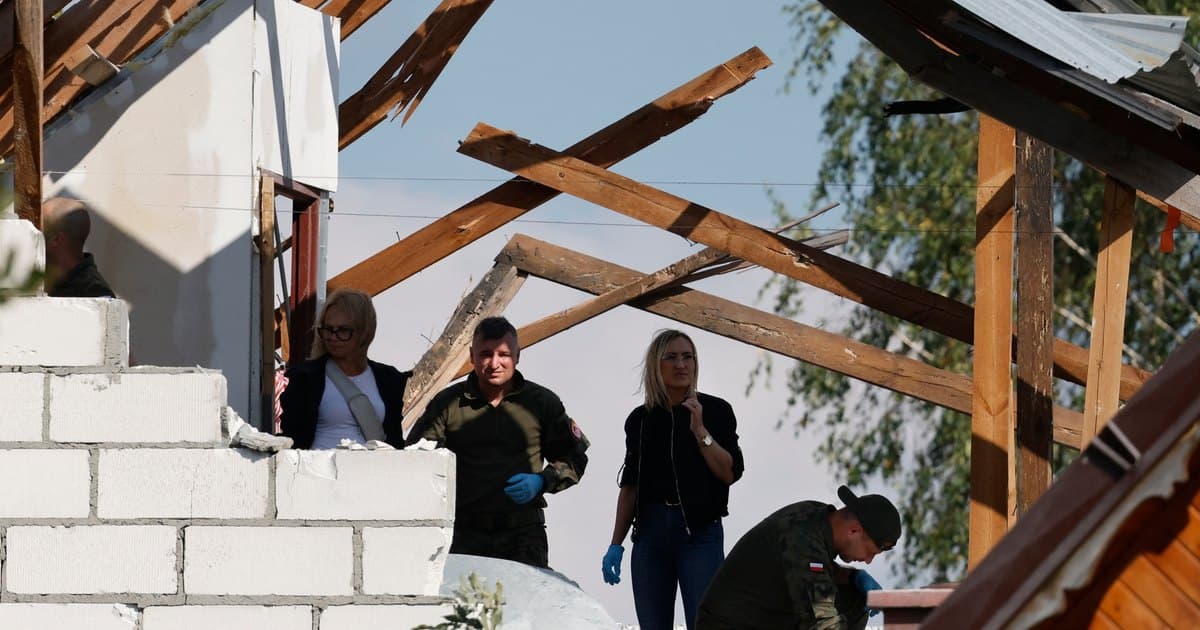
Polish Border Village Braces for Escalation After Russian Drone Blasts
Residents of Dorohusk, a Polish village on the Ukrainian border, are preparing for possible Russian escalation after drones exploded nearby and border crossings were repeatedly disrupted.
Residents of Dorohusk, a village in eastern Poland on the border with Ukraine, are confronting a new sense of unease after Russian drones exploded just kilometres away on the Ukrainian side of the frontier.
The blasts in the early hours of September 13 near the Dorohusk-Yahodyn crossing were clearly audible in the Polish village. Three times in a single day, phones across the community lit up with warnings that a drone or missile could cross into Polish territory and that residents might need to take cover.
"There is new restlessness and fear because you could hear those explosions very well on that night in our village," said Wojciech Sawa, mayor of the Dorohusk commune. "We had never had something like that before. This was the first time the sirens wailed."
The Dorohusk-Yahodyn border crossing, about two kilometres from the village, was evacuated for roughly half an hour around midday because of the nearby air attack. Border procedures were suspended twice more that day.
"Today we have already had the third interruption of border processing at the Dorohusk and Zosin crossings," said Dariusz Sienicki of the Polish border guard. "In two cases, no evacuation was ordered, while in one case an evacuation was ordered, so the situation is dynamic."
Polish Prime Minister Donald Tusk warned on September 17 that Russia was planning hybrid strikes with drones or rockets on European countries supporting Ukraine, among them Poland. He said regions bordering Ukraine would be especially vulnerable in the coming months. Other European leaders and intelligence services have shared similar warnings.
For Dorohusk, the war has been a presence for years. Residents watched Ukrainian refugees flee across the frontier after Russia's 2022 invasion, and in July a Russian missile passed through eastern Polish airspace before crashing about 90 kilometres inside the country.
The recent drone attacks and the government's efforts to prepare the population for further incidents have brought fresh apprehension and confusion. Krzysztof Rulka, a resident, said people need clear guidance on what they are fleeing and where to go.
"If someone told me that a drone was going to explode in the centre of Dorohusk, then I would know what to do," he said. "But this kind of confusion — an air attack somewhere in Ukraine — well, what am I supposed to do now? Run to Germany?"
Children in border regions must evacuate when sirens signal an air threat. Jaroslaw Wojcicki, principal of the Dorohusk Primary School, said staff, including the school psychologist, now discuss safety with students almost daily. The school has been evacuated once so far. Two basement rooms used as shelters have had their windows boarded up to prevent glass shards from causing injuries.
"The older children had no problem at all, without showing any particular emotion," Wojcicki said. "You could see a little fear among the younger children, but they were well looked after by their teachers."
Another resident, Irena Popek, said she was trying to carry on. "For now, I sleep well at night, so I don't really hear it, but I hear planes flying, so what can I do? I simply have nowhere to hide, and that's it."
Poland's defence minister, Wladyslaw Kosiniak-Kamysz, visited the Dorohusk-Yahodyn crossing on September 22 and announced that new air defence elements were being deployed to the border region. He said Patriot batteries are currently stationed in the two Polish regions bordering Ukraine, including the one containing Dorohusk.
In Lublin, Miroslaw Sokal, director of the city's Department of Resident Safety and Crisis Management, said preparedness remained a work in progress.
"We are at the beginning of the process of building civil resilience and the resilience of the state to threats," he said. "We have to remember that over the past 40 years, we thought we would be living in peace by now. The current situation shows that we need to change the way we think and take this element of threat into account in our plans."