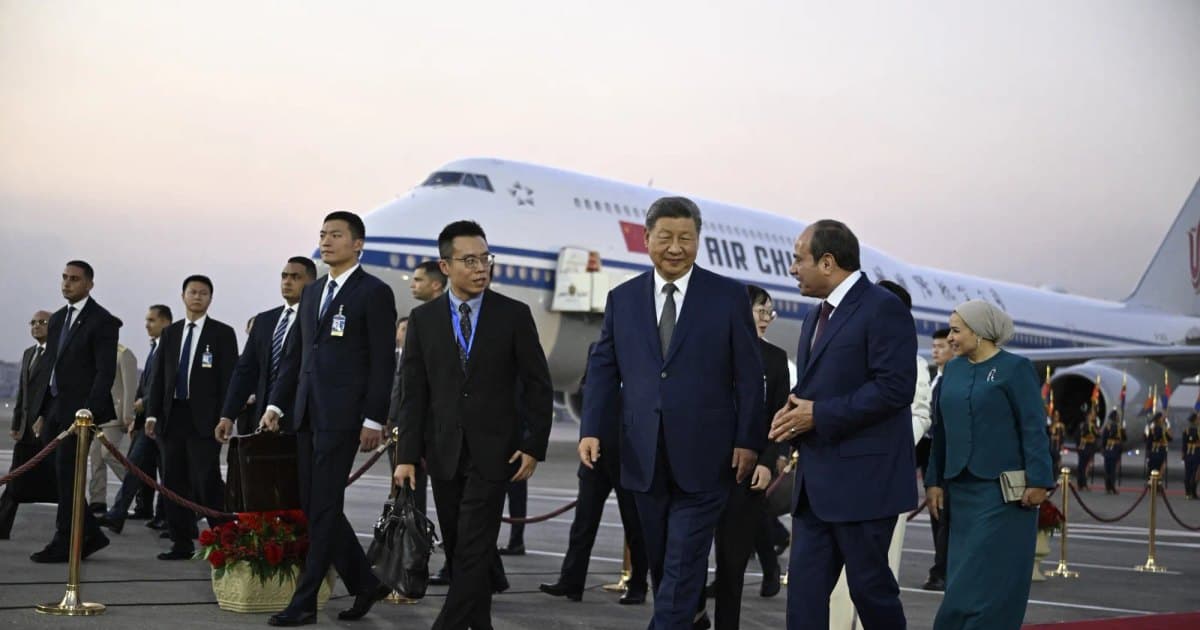
Egypt rolls out red carpet for Xi as Cairo deepens China ties
Xi Jinping's Cairo visit highlights Egypt's balancing act between its US security partnership and growing economic and military cooperation with China.
Egyptian President Abdel Fattah al-Sisi received Chinese President Xi Jinping in Cairo on Wednesday, marking the first visit by a Chinese leader to Egypt in ten years. The ceremonial welcome at the Ittihadiya presidential palace signals a deepening of ties between the two nations, set against a backdrop of regional instability and shifting alliances.
The visit comes after months of upheaval in the Middle East, including the US war against Iran, which has strained regional economies and prompted some American partners to reassess their security arrangements. Egypt, which receives approximately $1.3 billion in annual US military aid, has been steadily expanding its economic and military cooperation with Beijing since 2014, when Sisi signed a strategic partnership agreement during a visit to China.
Former Egyptian diplomat Ayman Zaineldine noted that Cairo's push to diversify its alliances aligns with Beijing's ambitions beyond Asia. "Egypt wants to widen the circle of its relations with major world powers, including China," he said. "So the visions converge."
Cairo's streets have been adorned with Chinese flags and imagery featuring landmarks such as the Sphinx and the Great Wall, reflecting the enthusiasm surrounding the visit. Egyptian state media has highlighted favourable Chinese opinions of Egypt and aired segments on modern Chinese weapons systems.
Military cooperation was showcased last month during the "Eagles of Civilization" exercises, which included an unusual air combat drill involving Chinese-made J-16 jets and French-built Rafale aircraft. Egypt's strategic location, home to the Suez Canal and a population exceeding 110 million, makes it a vital partner for China's ambitions in the region.
Economic ties are substantial, with Egyptian data showing imports from China surpassed $10 billion in the first half of the year, a 14% increase year-on-year. Chinese firms have invested heavily in Egyptian infrastructure, including container ports, green hydrogen projects, and manufacturing. China State Construction Engineering Corporation has also been a key developer in the business district of Egypt's new administrative capital east of Cairo.
H. A. Hellyer, a scholar at the Royal United Services Institute, described Egypt's value to Beijing: "A large domestic market for investment opportunities, and a lot of diplomatic weight in the region, including the Palestine question, as well as connectivity to Africa."