Europe's Winter Gas Crisis Threatens Economic and Strategic Ambitions
European gas prices have doubled due to the Iran war, threatening economic stability and strategic plans.
European natural gas prices have surged to €75 per megawatt hour, more than double their level from a year ago, driven by the closure of the Strait of Hormuz. This disruption has choked off roughly a fifth of global LNG supplies, forcing Europe and Asia into fierce competition for remaining cargoes. A scorching Asian summer diverted shipments eastward, severely hampering Europe's efforts to refill its underground storage before winter.
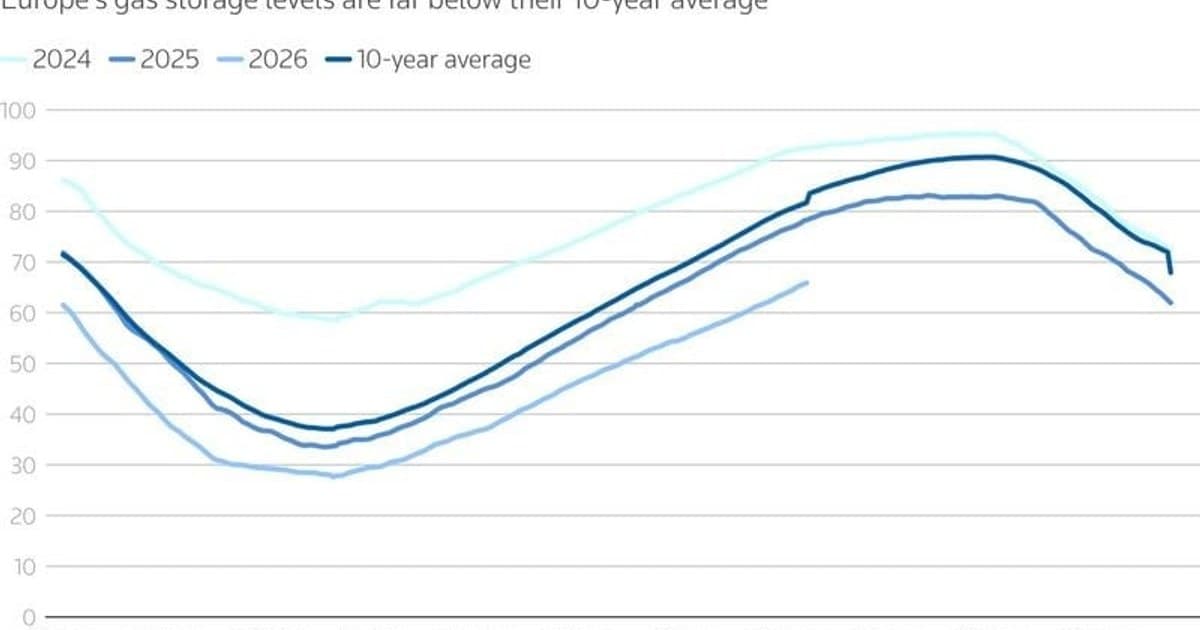
Storage levels across the continent are now critically low. European gas storage sites are only about 66% full, the lowest for this time of year in 15 years and roughly 12 percentage points below last year's level. Germany's network stands at just 54% capacity, while the Netherlands is at 48%. Analysts expect inventories to peak this year at only 70% to 75%, compared to 83% in 2025. This will increase reliance on spot LNG cargoes and pipeline imports, putting further upward pressure on prices.
The supply disruption shows no signs of easing. LNG exports from the Gulf fell by more than 85% between March and August compared to a year earlier. QatarEnergy has extended its force majeure suspension on deliveries until early November. However, rapid production growth in the U.S. and Canada has offset roughly 75% of the Middle Eastern losses, preventing a repeat of the 2022 crisis when prices briefly exceeded €300 per MWh.
The timing is particularly damaging for Europe's economy. The continent is racing to rearm amid rising tensions with Moscow and pressure from Washington to increase defence spending. It is also scrambling to catch up in the AI arms race, which requires heavy investment in power-hungry data centres. Meanwhile, European manufacturers, especially carmakers, are losing ground to lower-cost Chinese competitors. A prolonged surge in energy prices would worsen Europe's cost disadvantage, squeezing profits or forcing companies to pass costs onto consumers.
The European Commission has stated there is no immediate risk to supply security this winter. However, the central concern is not whether Europe can secure enough gas, but the price it will have to pay. With Europe's gas import bill already reaching €117 billion in 2025, another sharp increase could undermine the very ambitions the continent sees as essential to its future economic and strategic autonomy.