FCNR inflows flood banking system, drag short-term borrowing costs sharply lower
A surge in FCNR(B) deposits has flooded the banking system with liquidity, pulling short-term certificate of deposit rates down by over 100 basis points from their peaks.
A surge in foreign currency non-resident (FCNR) bank deposits has flooded the domestic banking system with liquidity, sharply pulling down short-term borrowing costs for lenders. According to research by ICICI Bank, interest rates on three-month certificates of deposit (CDs) have dropped by more than 100 basis points from their peak this year.
The impact is most visible in the short end of the money market, where rates have moved well below the policy repo rate. Six-month and one-year CD rates have also declined by around 100 and 90 basis points, respectively, from their earlier highs.
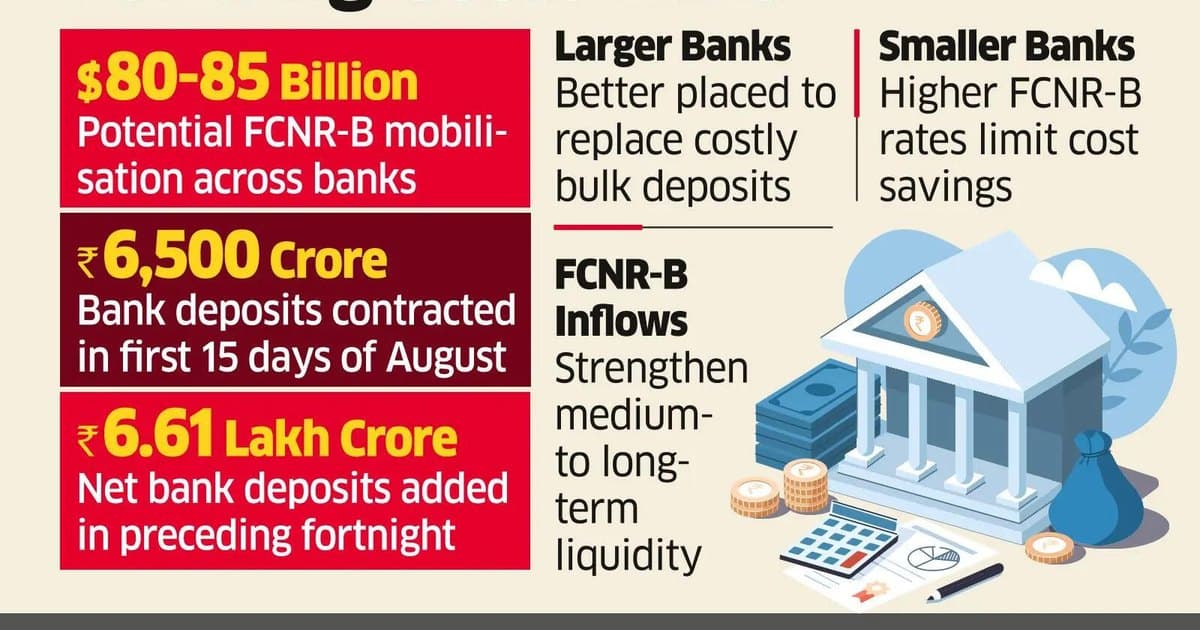
The shift follows gross FCNR (B) inflows of roughly USD 127 billion, which have significantly altered the liquidity outlook for the remainder of the financial year. Average system liquidity, which stood at around INR 1.6 lakh crore (0.6 per cent of net demand and time liabilities) in May, rose to INR 3.7 lakh crore (1.3 per cent of NDTL) by August. Current liquidity has now swelled to approximately INR 10.5 lakh crore, or 3.9 per cent of NDTL.
ICICI Bank expects the surplus to remain elevated, projecting it at around 2.5 per cent of NDTL by March, even after accounting for seasonal currency demand and reserve requirements.
The report also flags a potential lagged impact on inflation. Historical data shows a correlation of 0.50 between system liquidity and core consumer price inflation with a 12-month lag, rising to 0.62 for core inflation excluding precious metals. "Today's liquidity has an impact on 'future' inflation," the research note warns, suggesting the current surge could push price pressures higher down the line.
The bank projects headline inflation at 4.5 per cent for FY28, with core inflation (excluding precious metals) around 4 per cent. Given the surplus, it argues for a mix of permanent and temporary liquidity absorption, including long-term variable rate reverse repo operations (VRRR) to retain flexibility.
On the policy front, ICICI Bank anticipates a shallow rate-hike cycle. It estimates a 50 basis point increase in the policy rate would bring real rates towards the lower end of the neutral range, while a 75 basis point hike would be sufficient if inflation exceeds current projections.