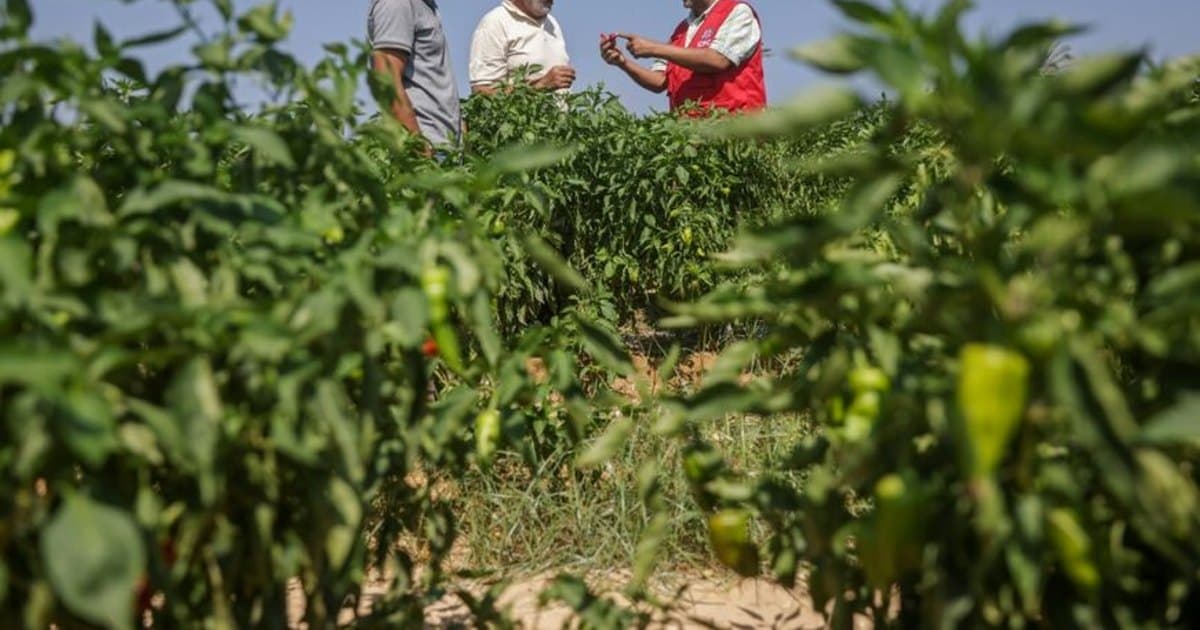
Gaza farmers rebuild seed bank to save native crops
Gaza farmers are rebuilding a destroyed seed bank to preserve native crops and cultivate the little land left available.
A group of farmers in Gaza is working to preserve the enclave's native crops by rebuilding a local seed bank that was destroyed during the war. The effort also encourages Palestinians to cultivate what little viable land remains.
Most of Gaza's pre-war farmland is in an area under Israeli military occupation. The entire population of about 2 million is confined to roughly 30% of the territory, much of which has been devastated by bombardment.
Salama Muhanna, a 71-year-old farmer, said his "Bank of Seeds" in Qarara town was destroyed in early 2024. Before the war, the facility held 70 tons of seeds for 42 different crops, including black-eyed peas, watermelon, and sage. It was equipped with refrigerators, solar power, a dryer, and a seed-cleaning machine.
Muhanna and his team have since rebuilt a modest stock of about 32 local seeds, with contributions from farmers who worked with the bank before the war. The seeds are now stored in burlap sacks and plastic containers in a makeshift tent in Deir Al-Balah. The team also cultivates seedlings in nearby fields.
Local heirloom seeds are more resilient than imported hybrid varieties, as they can be saved and replanted year after year. Farmers see the seed bank as protection against border closures and supply restrictions, though it does little to offset the broader devastation of Gaza's agricultural sector.
A June report by Gaza's Agriculture Ministry said about 560,000 people depended wholly or partly on agriculture and fishing before the war. Osama Al-Mukhalalati, an agricultural engineer with the International Committee of the Red Cross, said the current seed bank efforts represent "only a drop in the ocean" compared with the sector's needs.
Mustafa Al-Astal, who runs a nursery in Khan Younis, said local seeds had become "the only lifeline" when Israel tightened import restrictions during 2025. Israel said the measure was aimed at pressuring Hamas during ceasefire talks, but it was condemned as collective punishment and linked to famine conditions.
Much of Gaza's farmland lies along or beyond the "Yellow Line," to which Israeli troops were meant to withdraw under an October 2025 ceasefire. Farmers say the line has been moved deeper into Gaza, putting more land off limits and exposing those who work nearby to gunfire.
Khaled Al-Astal, a farmer planting seeds from the bank about 500 metres from the Yellow Line, said he and others have no plans to leave. "We only have about 25% to 30% left," he said. "So we say: we are here on our land, and we will cultivate it despite them."