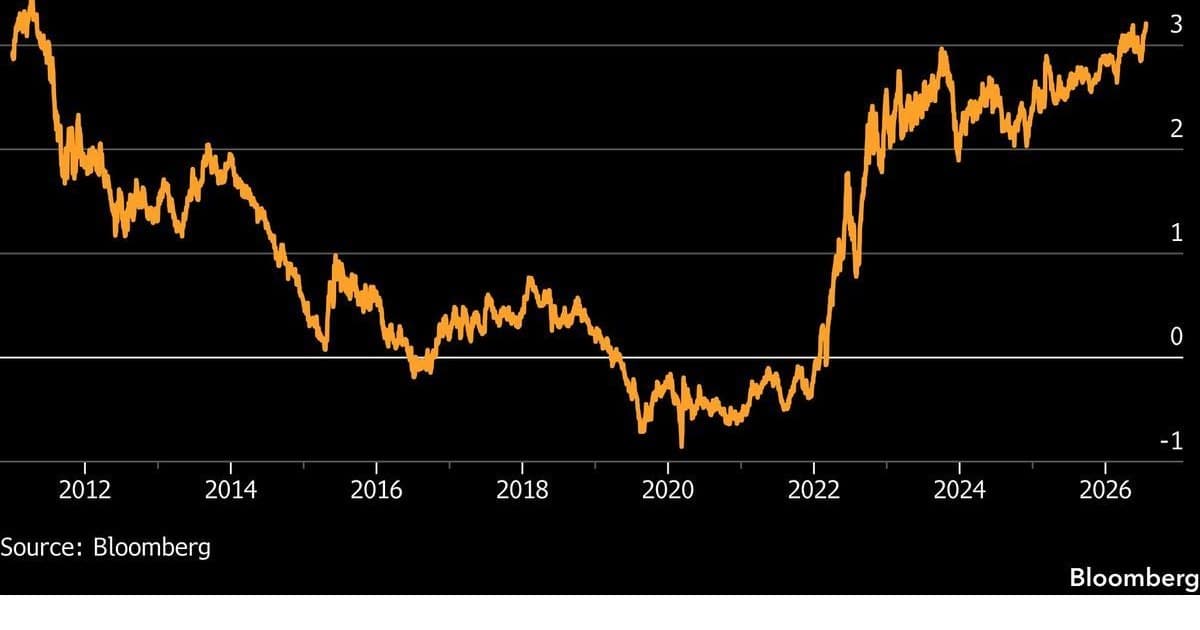
German Bond Yields Touch Multi-Year Highs as Oil Climbs and Fed Signals Tightening
German bond yields hit multi-year highs on Monday as oil prices rose and Fed Chair Warsh hinted at possible rate hikes if inflation persists.
German government bond yields reached fresh multi-year highs on Monday, driven by climbing oil prices and hawkish signals from the US Federal Reserve. Fed Chair Kevin Warsh indicated that interest rates may need to rise if inflation remains above target, a comment that has reverberated through global fixed-income markets.
Brent crude futures rose 0.5% to $89.80 per barrel after the US announced an attack on an Iranian island in the Strait of Hormuz. Tehran said it had responded by targeting US assets in the region, though the UAE denied reports that Al Minhad Air Base had been struck by missiles.
Germany's two-year bond yield was flat at 2.89%, after touching 2.9014% earlier in the session — its highest level since July 2024. The benchmark 10-year Bund yield rose 1 basis point to 3.28%, reaching 3.2903% intraday, the highest since May 2011.
US two-year Treasury yields had jumped on Friday following Warsh's comments, with the yield curve flattening. In early London trade on Monday, they were down 2.5 basis points after rising 12 bps on Friday. The benchmark 10-year Treasury yield fell 1 bp after gaining 5 bps on Friday.
"Overall, Bunds cannot defy US Treasuries headwinds, but should still outperform as the market is well-prepared for the next ECB rate hike," said Rainer Guntermann, rate strategist at Commerzbank. He added that month-end flows should provide temporary relief.
Traders are pricing the European Central Bank's deposit rate at about 2.70% by December, implying an 80% chance of a second rate hike after one widely expected in September, from the current 2.25%. Markets also suggest investors are positioning for rates to move closer to 3% by late 2027, with the deposit rate priced at 2.94% by September 2027.
"Our base case remains that steady progress in underlying inflation will allow the Fed to keep rates unchanged this year," said Mark Haefele, chief investment officer at UBS Global Wealth Management. "Although the risk of a September hike has increased, the latest sequential inflation data remain consistent with further disinflation."
French borrowing costs remained near their highest levels in over 18 years as the country faces a difficult budget battle in the coming months. Yields on France's 10-year bond stood at 4.1284%, after hitting 4.1433% a couple of weeks ago — its highest since November 2008. The spread over Germany's benchmark Bund yield was 84.30 bps, after hitting 88.30 bps last week, its widest since November 2024.