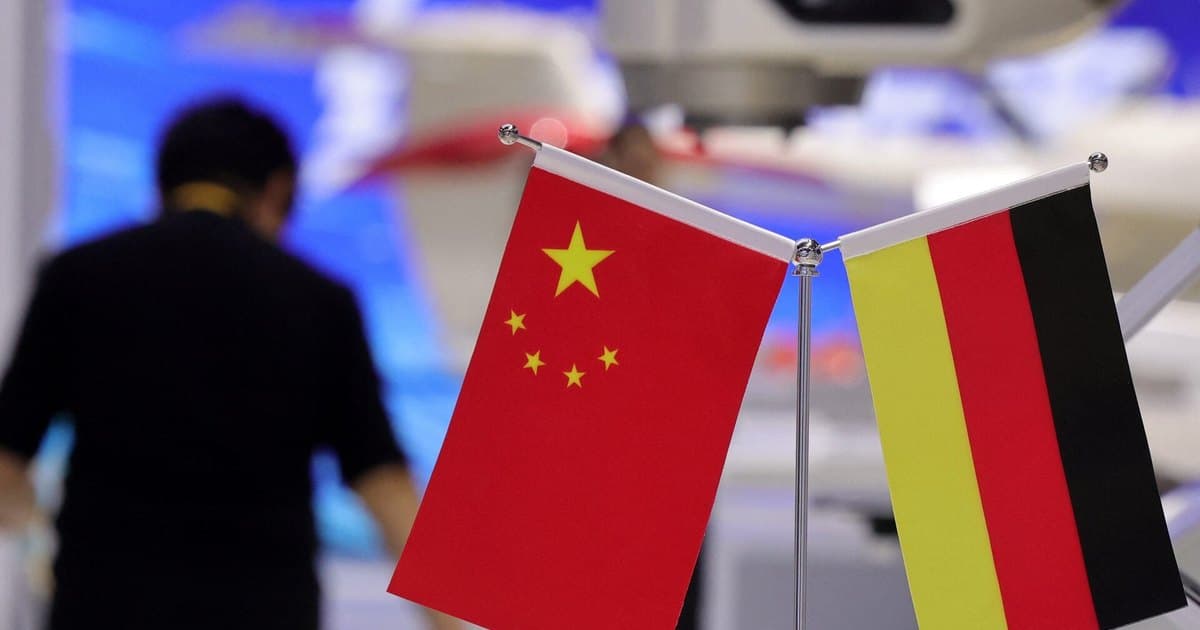
China's export push forces German industry to rethink its playbook
Germany's export-driven economy is under strain as Chinese competitors match quality at lower prices, forcing firms to adapt or lose ground.
For decades, Germany's economic engine has been powered by exports of complex, high-value goods — cars, machinery, locomotives, and aircraft. That model is now facing its stiffest test yet, as Chinese manufacturers increasingly produce goods of comparable quality at significantly lower prices.
Economists call this the "China shock," and it is emerging as a central factor behind Germany's prolonged economic stagnation since the pandemic. The slowdown has weighed on public sentiment, complicating the political landscape for Chancellor Friedrich Merz's coalition ahead of a key regional election in Saxony-Anhalt.
German companies that once earned substantial profits selling to China now find themselves competing against Chinese exports in Europe and other markets. With domestic demand in China weak, Beijing is encouraging manufacturers to sell abroad, often in sectors where German firms have traditionally led.
Europe's largest economy has shrunk in 2023 and 2024, with only marginal growth last year. While unemployment remains relatively low, headlines about job cuts at iconic firms — tens of thousands at Volkswagen, thousands of buyouts at BMW, and major reductions at Bosch — have unsettled the public. Inflation has also outpaced wage growth in recent years.
Some companies are responding by rethinking their strategies. Jungheinrich, a German maker of warehouse vehicles, has partnered with Chinese manufacturer EP Equipment to produce a low-cost forklift. The machine is simpler and less feature-rich than its premium German counterparts, but it sells at roughly half the price, targeting customers who don't need round-the-clock operation.
Volkswagen, meanwhile, has adopted an "in China, for China" approach, developing vehicles locally to better compete in that market.
German policymakers are wary of repeating the solar industry's fate, where Chinese competition drove domestic manufacturers into bankruptcy. The government has announced a large infrastructure fund and tax relief measures to stimulate growth.
Economists argue that a coordinated European response may be necessary. The EU has imposed targeted tariffs on some Chinese goods, but experts say a broader strategy is needed to protect European markets while maintaining fair trade practices.