India's BRICS Chairship Puts Iran-UAE Mediation in Focus
As India hosts an expanded BRICS summit, suggestions from Iranian and Emirati diplomats have revived talk of a possible Indian mediating role between Iran and the UAE.
India is hosting this year's BRICS summit at a moment of unusual global turbulence, with two major wars underway and significant geopolitical realignments taking shape. Although India is not a direct participant in either the Ukraine or the Iran conflict, it has been substantially affected by both — and the Iran war has proved especially costly.
Disruptions to energy supplies from the Gulf have pushed up oil and gas prices, with knock-on effects on food and consumer goods, inflation, the rupee and overall growth. Indians have also lost their lives in a war in which the country had no part.
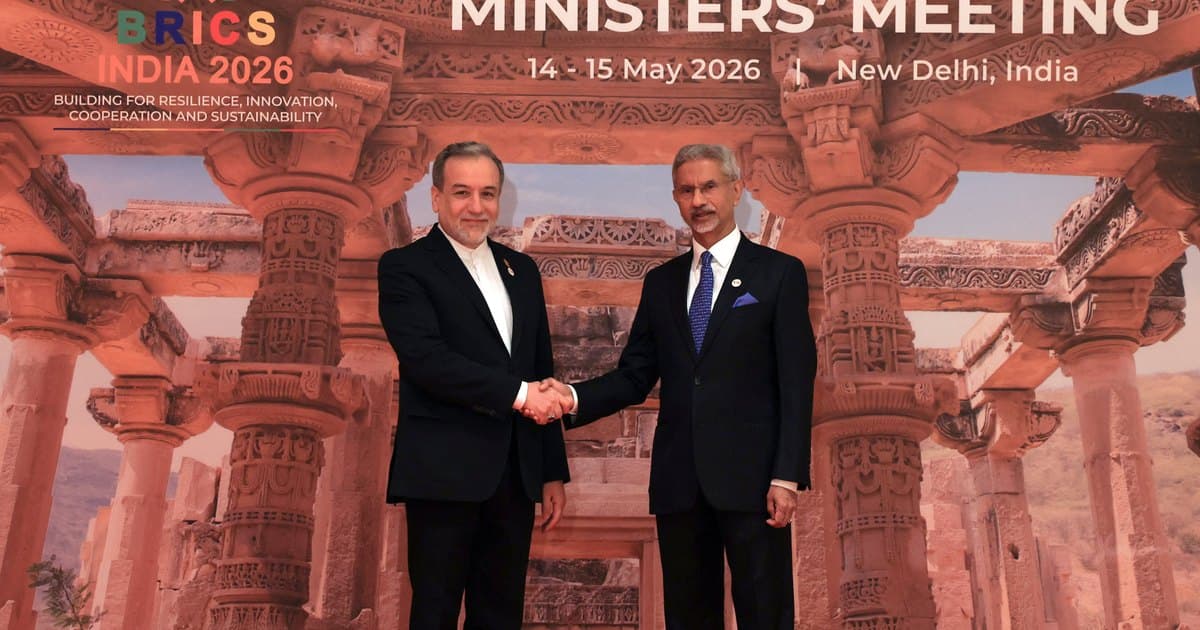
The summit brings together an expanded bloc of eleven member states, with ten more partner countries participating. Notably, three parties to the Iran conflict — Iran, the United Arab Emirates and Saudi Arabia — are BRICS members whose representatives are in Delhi. That has raised the question of whether India could help broker an understanding between Iran and the UAE, two geographically close neighbours whose fortunes are intertwined.
The divisions have already been felt within BRICS itself: a foreign ministerial meeting of member states ended without a joint statement because of differences of opinion, leaving India to issue a statement as chair.
Against this backdrop, Prime Minister Narendra Modi's recent bilateral meeting with Iranian President Masoud Pezeshkian in Bishkek, on the sidelines of the Shanghai Cooperation Organization summit, was seen as significant. It came amid US efforts to squeeze Iran economically and threats to sanction countries doing business with it, signalling that New Delhi values continued engagement with Tehran while acting in its own interest.
Iran matters to India both geopolitically and economically. It has been an important crude supplier and a critical export destination before sanctions took hold, and has often cooperated with India on counterterrorism. It is also central to India's Eurasian connectivity ambitions, including the Chabahar Port project, whose importance has grown with the closure of the Strait of Hormuz and uncertainty around Bab-el-Mandeb — two chokepoints vital to India's energy supplies and trade.
The UAE, meanwhile, has become an indispensable strategic partner and arguably India's closest Gulf ally, with cooperation spanning trade, energy security, labour, defence, space, culture and counterterrorism. Bilateral trade has risen sharply since the Comprehensive Economic Partnership Agreement, and India is the UAE's second-largest trading partner. Nearly four million Indians live and work in the Emirates. This year saw visits by UAE President Sheikh Mohammed bin Zayed Al Nahyan to India and by PM Modi to the UAE, producing agreements aimed at easing the costs the Iran conflict imposes on ordinary citizens.
Support for an Indian role has come from both sides. Early in the Israel-US war on Iran, former UAE ambassador to India Hussain Hassan Mirza said India was well positioned to mediate given its good relations with all parties, adding that PM Modi holds rare credibility across the region. More recently, Iranian Foreign Minister Abbas Araghchi echoed that view in Delhi during the BRICS foreign ministers' meeting, praising India's diplomatic standing and suggesting New Delhi could play a constructive role in promoting peace and stability in West Asia.
Such suggestions have precedent. In 1953, then prime minister Jawaharlal Nehru mediated between the USSR and Austria, helping pave the way for a sovereign, independent and neutral post-war Austria. Around the same period, from 1950 to 1954, India's troop deployment to Korea is widely credited with beginning a foundational chapter in global peacekeeping. This year, Defence Minister Rajnath Singh inaugurated an Indian War Memorial in Seoul commemorating that role on the 75th anniversary of the Korean War.
Stabilising ties between Iran and the UAE, observers suggest, would go a long way towards regional stability and a lasting resolution to the conflict. Both are neighbours with a long history of engagement, and the UAE has long served as Iran's window to the outside world and an economic conduit during sanctions. India, for its part, could count on the support of most BRICS members.