India's 6th-Gen Fighter Ambitions: Strategic Logic Meets Hard Realities
India explores GCAP and FCAS for 6th-gen fighters, but faces funding, workshare, and engine technology hurdles.
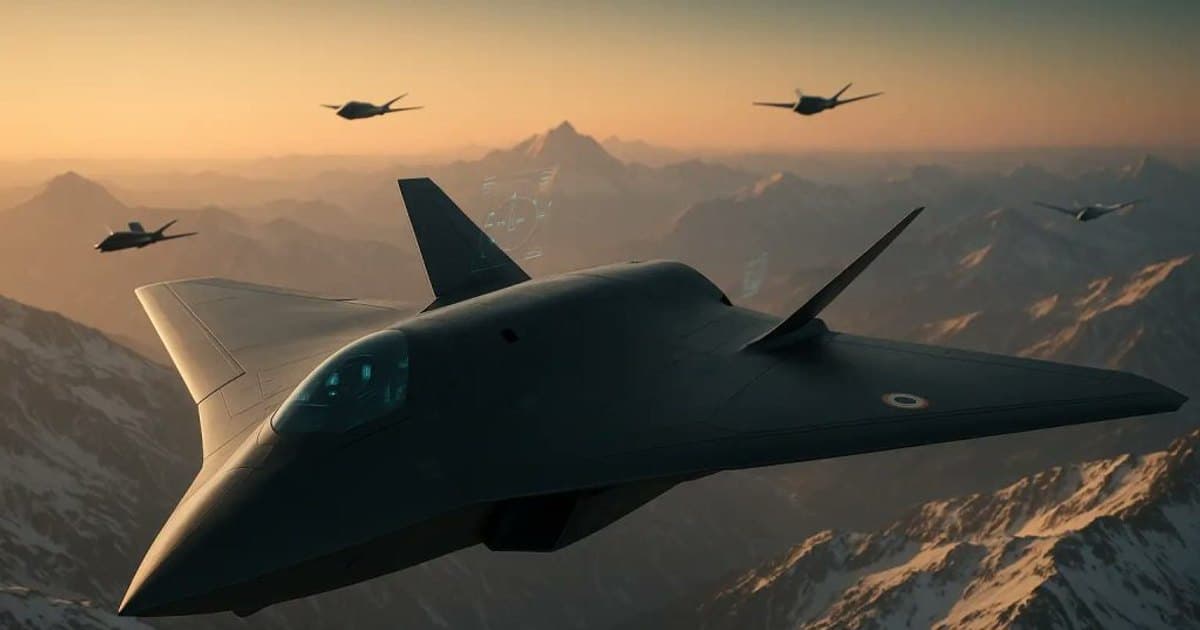
India's interest in sixth-generation fighter programmes is strategically sound, but the path forward is fraught with ambiguity and formidable challenges. The Indian Air Force (IAF) envisions a future where a fighter is not just an aircraft but a flying command-and-control node, integrating stealth, artificial intelligence, advanced electronic warfare, and manned-unmanned teaming. Such a platform would operate with autonomous 'loyal wingmen' and drones as part of a connected combat system.
However, this ambition arrives alongside a crowded defence-modernisation list. India is simultaneously pursuing the Tejas Mk2, the 114-aircraft Multi-Role Fighter Aircraft (MRFA) programme, and the Advanced Medium Combat Aircraft (AMCA). The financial and industrial strain of running these projects concurrently raises a critical question: can India sustain the speed and investment required for all of them?
The Aeronautical Development Agency (ADA) has pegged AMCA's research and development cost at approximately $1.8 billion, positioning it as a potentially cost-efficient fifth-generation project. Yet, comparable programmes tell a different story. China's J-20 is believed to have cost around $5 billion to develop, while Turkey's TF Kaan and Russia's Su-57 have each absorbed over $10 billion. The Tejas Mk2 is set to cost about $1.5 billion, and the MRFA is a staggering $39 billion commitment.
Defence Secretary Rajesh Kumar Singh confirmed in April that India has approached both major international partnerships—the Global Combat Air Programme (GCAP) involving Britain, Italy, and Japan, and the Future Combat Air System (FCAS) linked to France, Germany, and Spain. GCAP has moved into a detailed development phase with a GBP 4.6 billion contract awarded to the joint venture Edgewing. However, India's entry into this established partnership would likely mean a subordinate role in workshare, intellectual property, and decision-making.
The FCAS option has become a cautionary tale. The core fighter partnership between France's Dassault Aviation and Airbus collapsed in June 2026 after years of disputes over industrial responsibility. This breakdown underscores that joint development is as much about politics and industrial economics as it is about engineering.
Perhaps the most significant hurdle is the engine. Developing a high-thrust indigenous engine is estimated to cost around $10 billion. While the initial AMCA prototypes will use the GE F414, India seeks a collaborative effort for a more powerful engine for the Mk2 variant. Safran and Rolls-Royce have made proposals, but the fundamental question remains: if India cannot independently design a modern fighter engine, its sovereignty over a sixth-generation aircraft will be limited. The engine challenge is not solvable by procurement alone; it demands mastery of metallurgy, thermal management, and decades of accumulated design knowledge.