India's coal imports pivot to steel as metallurgical demand climbs
India's coal import mix is shifting toward steel-making grades, with metallurgical coal up 10.4% and thermal coal down 5.5% in FY2025-26.
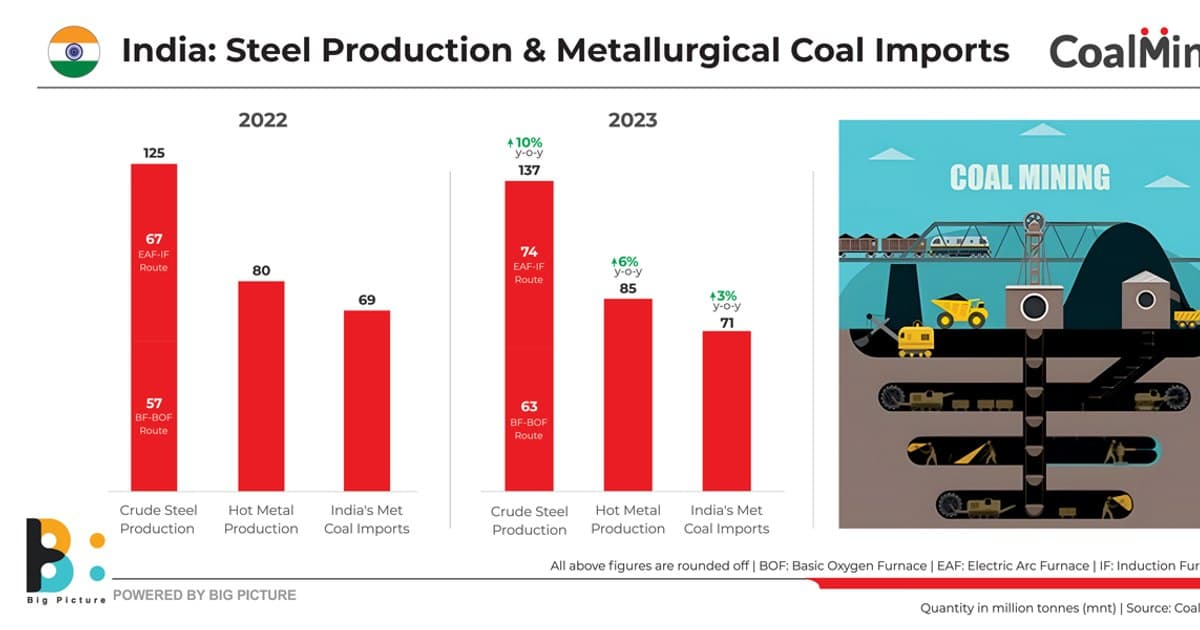
India's coal import basket is undergoing a structural shift, with demand increasingly driven by the steel sector rather than power generation. In FY2025-26, total imports of non-coking and metallurgical coal stood at roughly 244.2 million tonnes, nearly flat against the previous year's 245.3 million tonnes. But beneath that stable headline figure, the composition changed markedly.
Coking coal imports rose 12.4% year-on-year to 63.7 million tonnes, while pulverised coal injection (PCI) volumes grew 6.2% to 20.9 million tonnes. Together, metallurgical coal imports reached 84.5 million tonnes, up 10.4% from 76.3 million tonnes a year earlier, reflecting sustained demand from domestic steelmakers.
In contrast, non-coking coal imports fell 5.5% to 159.7 million tonnes, helped by improved availability of domestic thermal coal. This reduced reliance on imported fuel for power plants, even as steel producers continued to depend on overseas supplies for high-grade metallurgical coal that local mines cannot match in quality.
The shift is also reshaping India's supplier landscape. Russia emerged as a fast-growing source, with total shipments up 13.1% to 32 million tonnes. Russian coking coal deliveries rose 12.1% to 9.2 million tonnes, and non-coking coal imports from Russia jumped 20% to 7.5 million tonnes. Australia remained the key supplier of premium coking coal, with overall exports to India up 9.3% to 43 million tonnes, including a 13.4% rise in coking coal shipments to 34.3 million tonnes.
As domestic thermal coal output strengthens, India's procurement strategy is becoming more diversified and steel-centric. Future import trends are now likely to track steel production cycles more closely than electricity demand, a sign of the country's evolving energy and industrial landscape.