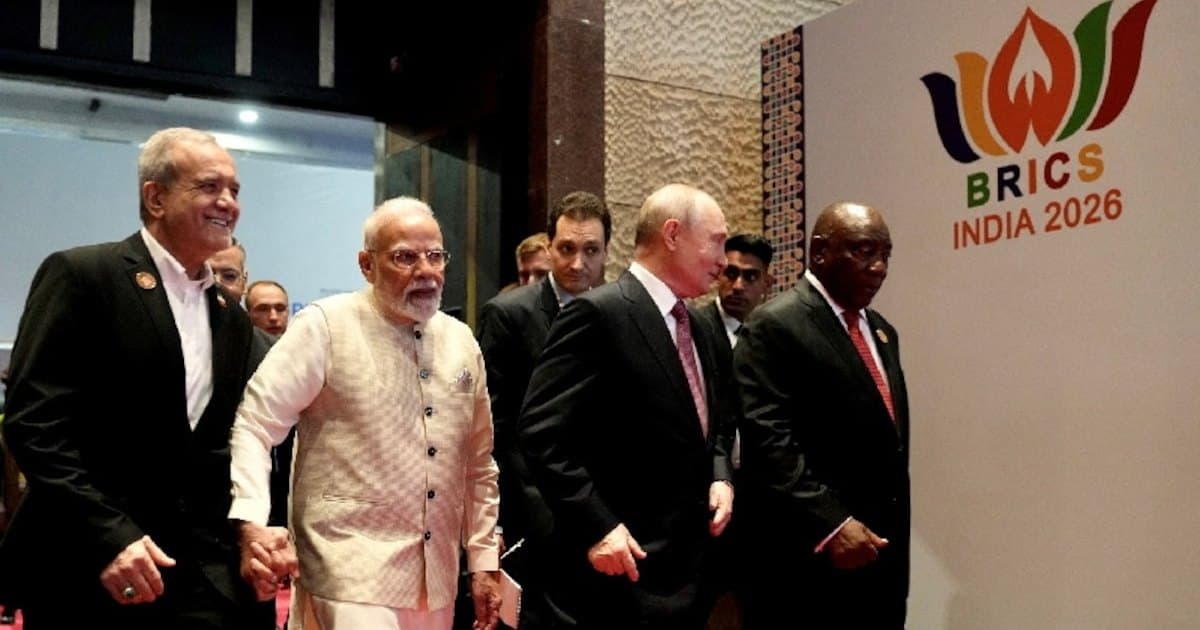
Iran, UAE leaders meet at BRICS Summit as New Delhi Declaration urges restraint
Iran's President and Abu Dhabi's Crown Prince held talks in New Delhi, while the BRICS New Delhi Declaration voiced deep concern over West Asia tensions.
Iranian President Masoud Pezeshkian and the Crown Prince of Abu Dhabi, Khaled bin Mohamed bin Zayed Al Nahyan, met in New Delhi on Saturday on the margins of the 18th BRICS Summit, with both sides voicing support for lowering tensions in West Asia.
The talks took place ten days after Iran struck military installations in the United Arab Emirates. According to the Abu Dhabi Media Office, the two leaders discussed regional and international matters of shared interest and stressed the value of backing efforts to ease tensions, encourage de-escalation and reinforce regional stability, while opening up prospects for peace and development for the region's people.
Iranian state media described the meeting as a continuation of Tehran's repeated calls to deepen ties with its southern neighbours.
Speaking separately on Saturday after talks with Malaysian Prime Minister Anwar Ibrahim, Mr. Pezeshkian said West Asia does not require the United States — which is at war with Iran — to act as a regional policeman. He said the region's territorial integrity and security could only be assured by its own principal actors and constituent countries.
The West Asia situation dominated the opening day of the summit, where the joint declaration issued after the leaders' dialogue avoided naming any of the contesting parties in order to secure consensus. The New Delhi Declaration, announced by Prime Minister Narendra Modi, expressed deep concern at the continued escalation of tensions in West Asia and, recalling the respective national positions of the members, urged maximum restraint and the avoidance of steps that could worsen the situation. It also underlined the need to keep global trade, supply chains and energy flows uninterrupted in line with applicable international law.
On Palestine, the declaration voiced deep concern over the continuing fighting in Gaza and called for an end to any policies aimed at the forced displacement of Palestinians, while pressing for a just and lasting solution to the Israel-Palestine conflict. It backed the establishment of a sovereign, independent and viable State of Palestine within the internationally recognised 1967 borders, encompassing the Gaza Strip and the West Bank with East Jerusalem as its capital.
The document said Israel carries a legal obligation to ensure humanitarian aid reaches Gaza, and called on it to honour the terms agreed with the Lebanese government and withdraw its occupying forces from all Lebanese territory. It also took a firm line on attacks targeting the United Nations Interim Force in Lebanon, which have persisted since the Israel-Palestinian conflict escalated in October 2023.
The declaration follows diplomatic gains for Iran at the SCO Summit in Bishkek earlier this month, where a joint statement condemned attacks on Iran and affirmed support for its territorial integrity and sovereignty.
Attention on West Asia grew further in New Delhi with the evening arrival of Saudi Foreign Minister Faisal bin Farhan Al Saud. The External Affairs Ministry had earlier condemned Houthi militia attacks on Saudi sovereign territory and on civilian and economic facilities, describing such strikes as unacceptable because they undermined regional security and stability and threatened freedom of navigation in the Bab-el-Mandeb.