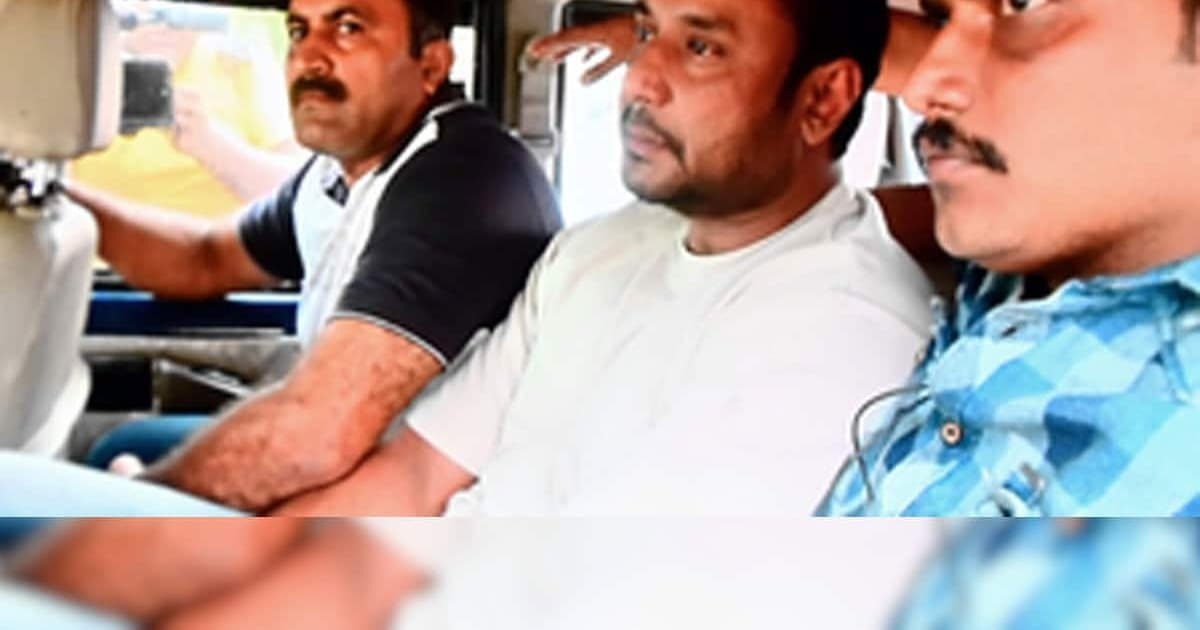
Karnataka HC seeks modalities for Darshan's trial appearance in Renukaswamy case
Karnataka High Court asks prosecutors and Darshan's counsel to propose modalities for examining key witnesses in the Renukaswamy murder trial, suggesting three alternatives to regular physical production.
The High Court of Karnataka on Thursday directed the Special Public Prosecutor and the counsel for actor Darshan to place before it the modalities for recording the examination of key prosecution witnesses and their cross-examination in the Renukaswamy murder case.
Justice V. Srishananda issued the direction while hearing a petition filed by Darshan, through his wife Vijayalakshmi, seeking permission to appear physically before the trial court in the city civil court complex during the trial, instead of attending proceedings through videoconference from the central prison in Bengaluru.
The court orally observed that arranging Darshan's regular physical production before the trial court for the entire duration of the trial may not be practicable. It put forward three alternatives for consideration: holding the examination and cross-examination of important witnesses on the prison premises, where a dedicated facility for conducting proceedings exists; allowing the accused to consult his advocates privately and confidentially through videoconferencing on the trial court's official infrastructure before each hearing; or producing him physically before the trial court for three to four days so that the examination of key witnesses can be completed within that window.
At this point, Special Public Prosecutor P. Prasanna Kumar informed the court that he had already proposed before the trial court that the actor's physical production could be permitted for a few days during the examination and cross-examination of important witnesses.
After asking the prosecutor and senior advocate Hashmath Pasha, appearing for Darshan, to specify the modalities they wish to adopt, the High Court adjourned further hearing on the petition to September 16.
The petition challenges a trial court order of August 17 rejecting the request for physical production, which had been sought on the ground that his advocates were unable to get adequate time in prison to obtain effective instructions from him for the trial. Darshan had also cited frequent interruptions and technical difficulties during videoconference proceedings.
The trial court had held that production of the accused, including Darshan, through videoconferencing had not so far affected any of their substantive or procedural rights. It had, however, directed prison authorities to allow his advocates to interact with him without unreasonable restriction, and asked the court registry to ensure there was no hindrance to the videoconference facility on the jail premises.