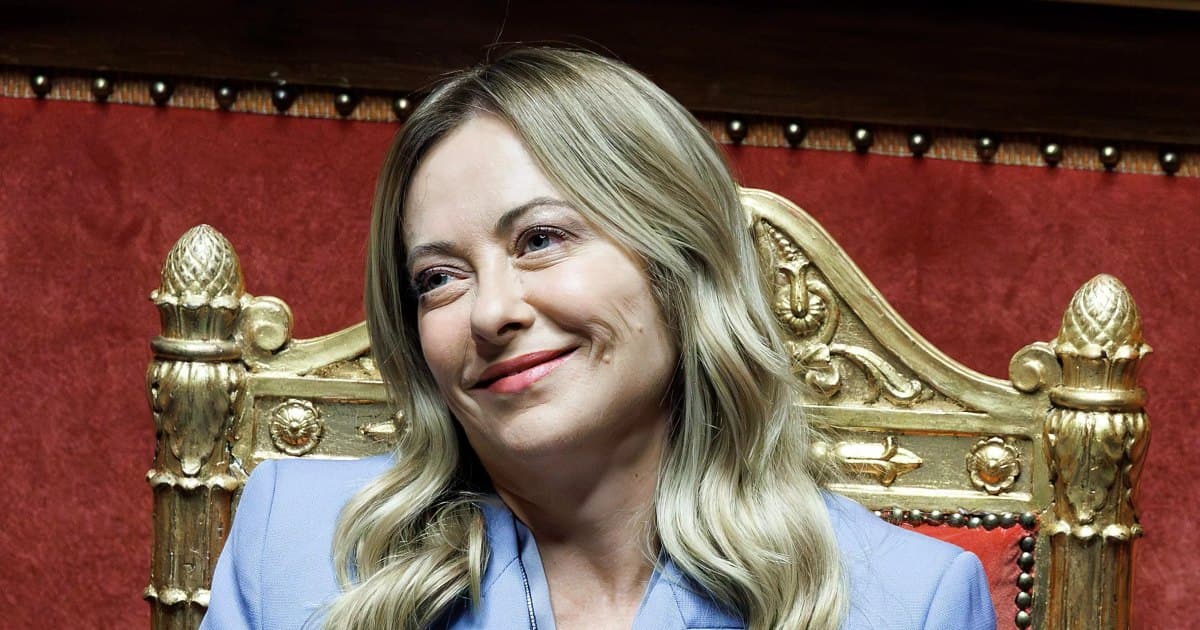
Meloni's coalition becomes Italy's longest-serving post-war government
Italy's Meloni government sets a post-war longevity record, but analysts and opponents debate whether stability has translated into structural reform.
Rome: Italy's governing coalition, led by Prime Minister Giorgia Meloni, has crossed a historic threshold. On Thursday, the administration completed 1,413 days in office, making it the longest-serving uninterrupted government in the country since World War II. The previous record was held by the late Silvio Berlusconi's administration from 2001 to 2005.
Meloni's party is set to mark the occasion with a large rally in the southern city of Bari on Friday, ahead of the next general election, which is due by the end of 2027.
When Meloni took office in October 2022, she was Italy's first female prime minister and the first leader of a party with neo-fascist roots. European allies and financial markets initially viewed her with unease. However, her tenure has been marked by a pragmatic approach: consistent support for Ukraine, cooperation within European institutions, and a focus on fiscal discipline.
Her relationship with US President Donald Trump has also become a notable foreign policy asset. Analysts note that while political instability has reshaped governments in other European nations, Meloni has retained the same coalition partners since taking office—a rarity in modern Italian politics.
Defense Minister Guido Crosetto credited Meloni's personal determination and work ethic for her international credibility, though he conceded that domestic recognition has been slower to materialize.
Supporters point to achievements such as tighter public finances, the creation of over one million jobs, unemployment below six percent, and a sharp decline in migrant arrivals. Meloni has argued that her policies, focused on supporting businesses and job creators, have produced record-high employment levels.
Critics, however, contend that the government's longevity has not translated into substantial structural reform. Political analyst Lorenzo Pregliasco noted that while the government has been stable, it has achieved little in terms of overhauling Italy's weak productivity, demographic decline, or long-standing inefficiencies in healthcare, education, and public administration.
Opposition leaders, including former Prime Minister Giuseppe Conte of the Five Star Movement, have highlighted the rising cost of living. "The government is celebrating, but Italians are not," Conte said recently.
Some experts argue that Meloni's most significant impact has been abroad. "Italy has somewhat lost its role as Europe's black sheep," said Stefano Manzocchi, an international economics professor at LUISS University in Rome.
Meloni's transformation from nationalist outsider to a mainstream European leader has reassured investors. Her handling of a recent spat with Trump—responding to his claim that she "begged" for a photo by saying "Italy doesn't beg"—won her domestic praise.
Her evolution has also accelerated the mainstreaming of Europe's hard right, according to Nathalie Tocci, an international relations expert at Johns Hopkins University. While her supporters see this as proof that nationalist conservatives can govern responsibly, others view it as a weakness.
Retired Gen. Roberto Vannacci, known for hard-line positions on immigration, has launched his own political party, arguing that Meloni has abandoned the combative promises that energized her base. This could siphon off conservative voters and lawmakers who feel she has moderated too much in her pursuit of stability.
Meloni is still aiming for a milestone Berlusconi never achieved: an uninterrupted five-year term as a single government. Whether voters believe her administration has delivered enough to deserve another term remains the central question of her political future.