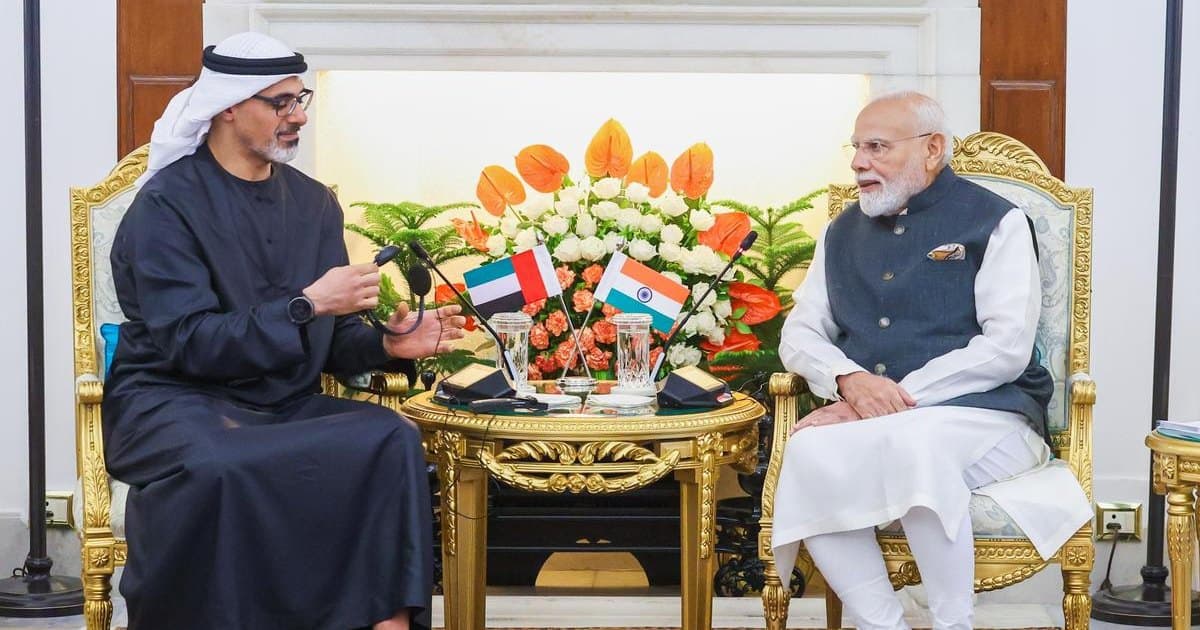
Modi Meets Abu Dhabi Crown Prince, Flags India-UAE Ties as Anchor of Stability
PM Modi held talks with Abu Dhabi Crown Prince Sheikh Khaled bin Mohamed bin Zayed Al Nahyan, discussing West Asia, BRICS and a $11.5 billion aluminium project in Odisha.
Prime Minister Narendra Modi met Abu Dhabi Crown Prince Sheikh Khaled bin Mohamed bin Zayed Al Nahyan on Saturday, a day after holding wide-ranging bilateral talks with visiting Iranian President Masoud Pezeshkian. Following the meeting, Modi described a strong India-UAE relationship as a symbol of stability, prosperity and peace at a moment of uncertainty in West Asia.
The two leaders reviewed the broader situation in the region and explored ways to advance the India-UAE strategic partnership. In a social media post, Modi said the discussions covered defence, artificial intelligence, space, critical minerals, energy, food security and connectivity.
The talks took place as BRICS members were reported to have reached a consensus on a joint statement after negotiations that stretched into the early hours of Saturday. The agreement was seen as significant because Iran, Saudi Arabia and the UAE belong to the same grouping despite differing positions on several regional and geopolitical questions. The main sticking point for negotiators had been the wording on the war in West Asia, with all three countries represented at the summit table.
According to the Ministry of External Affairs, Modi appreciated the UAE's active and constructive participation in BRICS during India's Chairship. Both leaders welcomed the outcomes achieved under India's leadership and agreed to keep working closely through the platform to advance shared interests and priorities, and to further strengthen BRICS cooperation.
The leaders also noted progress in bilateral relations across a range of sectors. They welcomed the announcement by UAE's International Holding Company to invest in a $11.5 billion integrated greenfield aluminium project in Odisha, described as India's largest integrated aluminium investment. The project is expected to help position Odisha as a global aluminium manufacturing hub.
Discussions also covered opportunities to deepen cooperation in strategic and emerging areas, including defence, space, nuclear energy, technology and innovation.
During the conflict in West Asia, New Delhi repeatedly voiced deep concern over the safety of nearly 10 million Indian citizens living and working in the Gulf region, noting that some Indian nationals had been affected or lost their lives amid the escalating violence. India has consistently urged all sides to exercise restraint, prioritise civilian safety and return to dialogue.
On the sidelines, Modi held separate bilateral meetings with leaders from Malaysia, Vietnam and Ethiopia, with talks focused on critical minerals, energy and food security as part of efforts to shield trade and supply chains from rising global tensions.