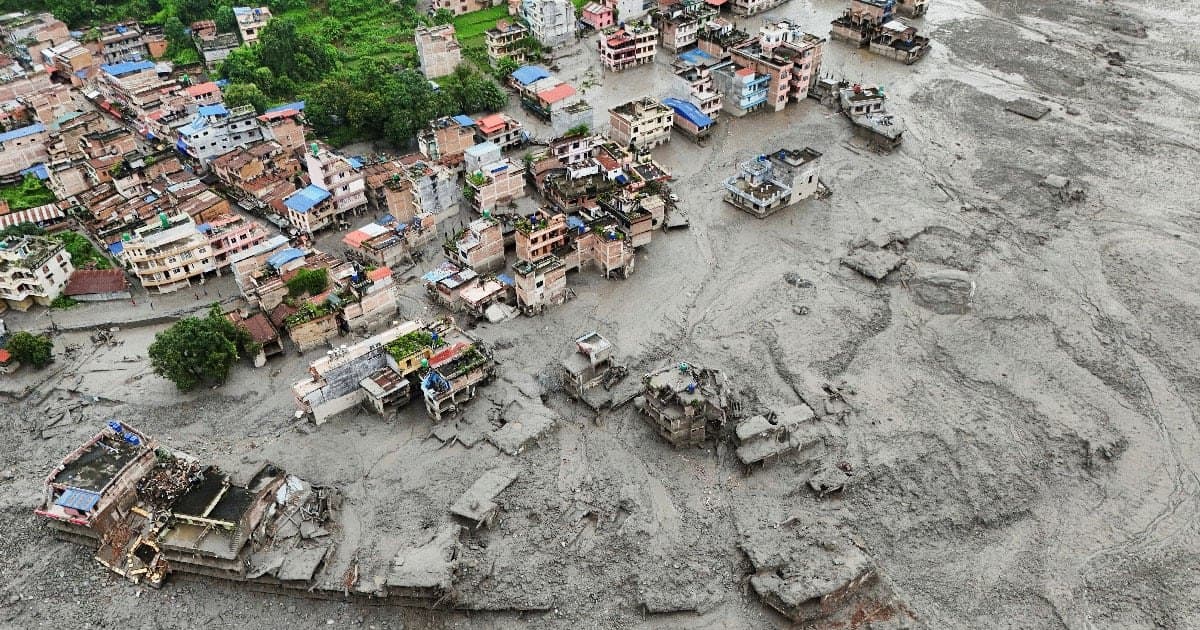
Nepal Flood: Glacier Landslide Sent Debris 100 km Down Trishuli
A glacier-related landslide near the Nepal-China border triggered a 100-km debris flow through Nepalese rivers, causing widespread devastation.
A catastrophic flood that tore through Nepal's mountainous rivers began with a seismic event high in the Himalayas, at the Nepal-China border. The initial tremor, recorded at 8:37 am Nepal time on August 26, was first logged as a magnitude 4.4 earthquake. However, scientists are now divided on its exact nature, with the US Geological Survey (USGS) revising its interpretation to suggest the seismic waves were generated by a massive landslide involving a glacier in Langtang National Park. The energy released was equivalent to a magnitude 5.2 earthquake.
India's remote sensing centre offered a different preliminary reading, suggesting a magnitude-4.9 earthquake triggered the glacier's collapse, with the sequence beginning on the Tibetan side. The International Centre for Integrated Mountain Development says the trigger remains unconfirmed.
The resulting debris—ice, rock, mud, and water—surged nearly 100 kilometres through the Lhende Khola, Bhote Koshi, and Trishuli rivers. The wave's first 22 km travelled at an average velocity of 193 kmph. It first flattened the Gyirong Port on the Chinese side, a key crossing for pilgrims to Kailash Mansarovar, before entering Nepal and striking Timure and Syapru Besi in Rasuwa. The surge devastated areas in Rasuwa, Nuwakot, and Dhading, with the Trishuli river rising nine metres in 30 minutes—an inland tsunami.
The floodwaters eventually calmed past Dhading, merging into the Narayani river and crossing into India at Triveni, above the Gandak barrage in Bihar. All 36 gates were opened, with discharge peaking at 1.50 lakh cusecs before falling. Uttar Pradesh also reported recovering seven bodies from rivers, believed to have been swept in from Nepal.
Upstream, the danger persists. China's Ministry of Water Resources has warned that a new barrier lake near the border is overflowing and at high risk of breaching, posing a continued threat of further flooding.