NMC Revises MBBS Seat Matrix for 2026-27, Warns Colleges Against Excess Admissions
The NMC has updated the MBBS seat matrix for 2026-27 to 1,40,214 seats across 836 colleges, warning that admissions beyond approved intake will invite penal action.
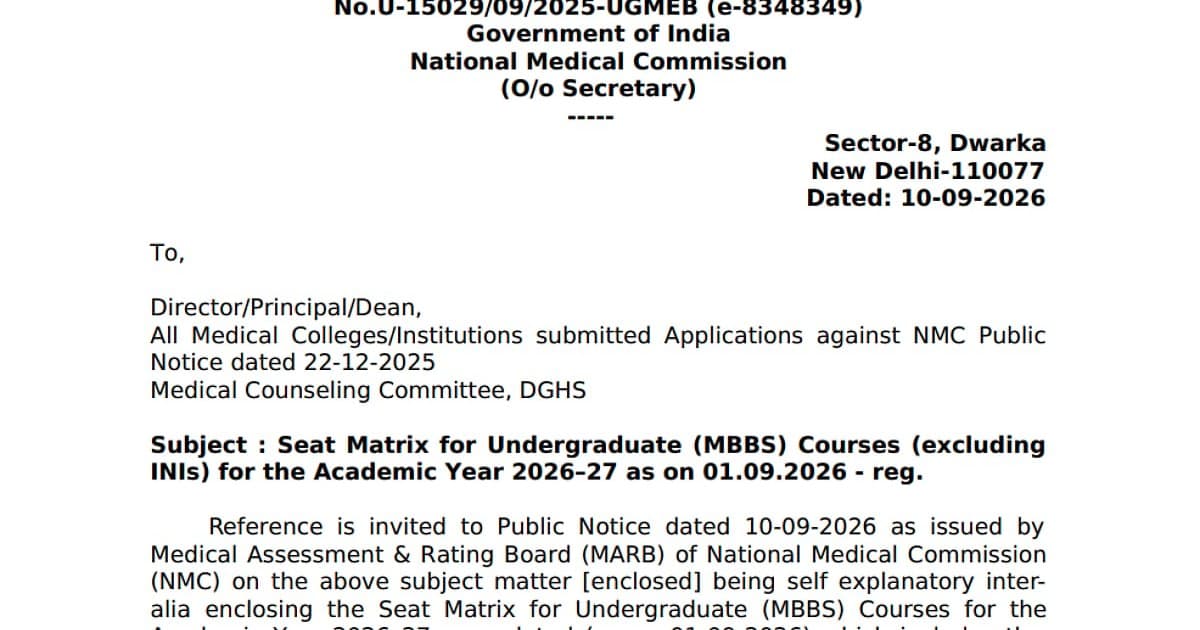
The National Medical Commission (NMC) has issued a revised MBBS seat matrix for the 2026-27 academic year, adding 13,186 seats to the earlier list, while cautioning medical colleges and counselling authorities against admitting students beyond the intake formally cleared by the regulator.
The updated matrix, released through a public notice earlier this month, reflects permissions granted for new medical colleges and for increases in the annual intake of existing institutions. These decisions were taken by the NMC's Medical Assessment and Rating Board (MARB), its first appeal committee, and the second appeal committee under the Union Health Ministry.
According to the revised figures, 1,40,214 MBBS seats are available across 836 medical colleges. This includes 63,971 seats in 391 government colleges and 76,243 seats in 445 private colleges. The previous matrix had listed 1,27,028 renewed seats. Of the 13,186 additional seats, 10,400 are in private medical colleges and 2,786 in government institutions.
The regulator has made clear that the matrix should not be treated as final. It remains subject to revision based on subsequent decisions by the appeal committees or other competent authorities. Any such changes will be uploaded on the NMC website and must be taken into account by the Central and State counselling committees.
Counselling committees have been specifically directed not to permit admissions against seats in excess of those approved and notified by MARB. The NMC said that under no circumstances should a medical college or institution admit students beyond its approved annual intake, warning that such admissions would amount to non-compliance with the National Medical Commission Act, 2019, and the regulations framed under it, and could attract regulatory and penal action.
Counselling committees have also been asked to refer any discrepancy between the seats being offered by a college and those appearing in the approved matrix to MARB for clarification.
The notice carries an additional condition for private medical colleges that have received permission either to establish a new MBBS college or to increase their annual intake but have not yet furnished the required electronic bank guarantee. Such colleges have been given seven days to submit the guarantee in favour of the Director, MARB. The letter of permission will be issued only after the guarantee is received, verified and found to be in order.
The clarification assumes significance as medical colleges continue to receive permissions and seek intake increases through the assessment and appeals process. It places the onus on counselling authorities to ensure that the number of seats offered to NEET-UG candidates corresponds strictly to the latest sanctioned capacity.
The revised matrix also means that students and counselling authorities will need to track subsequent changes rather than rely on earlier versions. All medical colleges have been directed to verify their institutional details in the latest matrix and to report any discrepancy or omission to MARB immediately, preferably before counselling begins.
The regulator's emphasis on sanctioned intake underscores the distinction between a college seeking or receiving approval for additional capacity and the actual issuance of the letter of permission. Until the prescribed regulatory requirements, including the bank guarantee where applicable, are completed, the additional seats cannot be treated as available for admission. Colleges have been asked to ensure that admissions for 2026-27 are made only against the seats notified in the latest matrix, as amended from time to time.