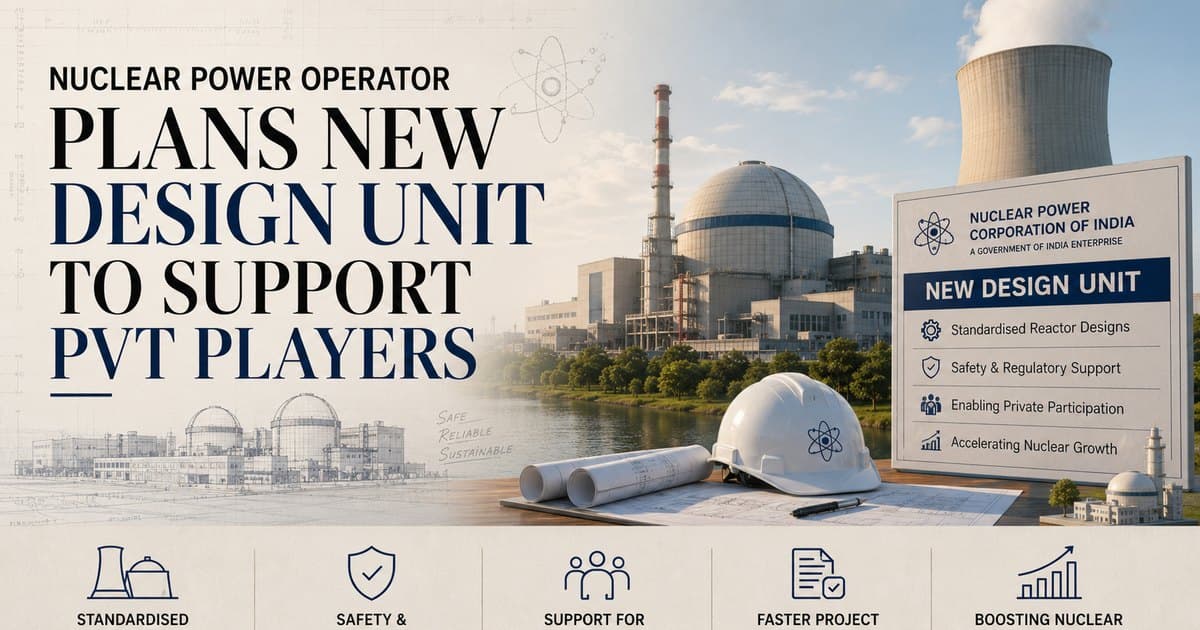
NPCIL to set up design vertical to support private nuclear entrants
NPCIL plans a new design vertical to support private players and states adopting indigenous PHWR technology, as India opens its nuclear sector.
The Nuclear Power Corporation of India Ltd (NPCIL) is planning to establish a dedicated design vertical to provide technological support to private companies and state governments interested in deploying indigenous pressurised heavy-water reactor (PHWR) technology. The proposal is currently under process, and the new unit is expected to act as a gateway for entities seeking access to PHWR design expertise, including technology support, design reviews, and quality assurance.
The move comes months after India's tightly regulated nuclear power sector was opened to private participation. The government has also released draft rules under the Sustainable Harnessing and Advancement of Nuclear Energy for Transforming India (SHANTI) Act, enacted in December 2025, which is expected to clarify the licensing framework for new nuclear projects once notified.
India currently has a nuclear power capacity of 8.7 gigawatt-electric (GWe), all operated by NPCIL. The Central Electricity Authority (CEA), in its roadmap for achieving 100 GWe nuclear capacity by 2047, has identified PHWRs as a prime candidate for adoption by other public sector undertakings and private companies. However, the CEA noted that NPCIL's own expansion plans may limit its ability to handhold new entrants, suggesting the need for a dedicated and independent entity under the Department of Atomic Energy (DAE) with experts from BARC and other specialised units.
Industry experts point to the cost advantage of indigenous PHWRs, estimated at around Rs 18 crore per MWe, compared with about Rs 34 crore per MWe for Russian reactors and significantly higher costs for French and US technologies. The established design standards and mature domestic supply chain are also seen as key advantages for PHWR deployment in the initial phase of expansion.
Last week, executives from Adani Atomic Energy and Jindal Steel indicated that the existing 700 MWe PHWR design could serve as a practical starting point for scaling up nuclear capacity. Both companies are planning to develop 10 GWe and 18 GWe of nuclear capacity, respectively, in the coming years. Foreign reactor technologies and small modular reactors (SMRs) are expected to play a role at a later stage as the sector matures.