OpenAI's Internal Workflows Now Run 3.1 Agent-Days for Every Human Workday
OpenAI reports its internal teams now deploy 3.1 agent-workdays of automated effort for every human workday, marking a major shift in AI research operations.
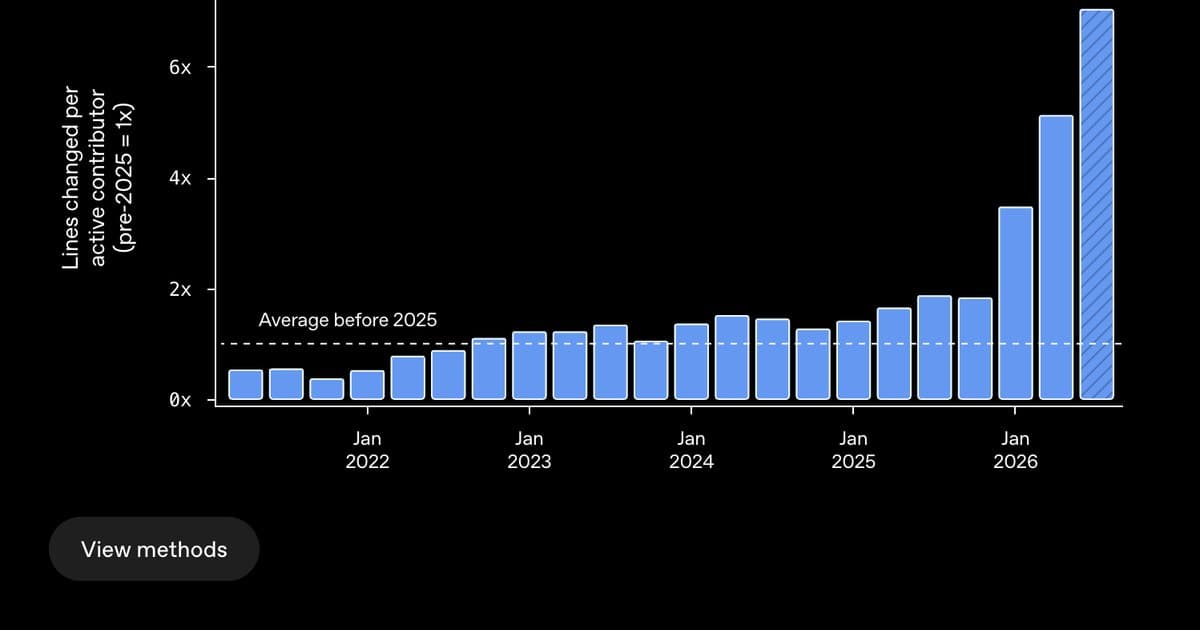
OpenAI has disclosed a significant operational milestone: its internal research teams now deploy 3.1 agent-workdays of automated effort for every single workday of human labor. The metric, shared in an update on the organization's research operations, signals a growing reliance on autonomous systems to handle routine engineering and technical duties.
According to the organization, agents are increasingly being used to resolve infrastructure problems that previously required specialist intervention. While automated workflows execute these routine tasks, human personnel continue to set research priorities and evaluate outcomes. "People still set research priorities and judge results, but agents give them more capacity to pursue promising ideas," the company noted.
The shift extends beyond day-to-day operations. OpenAI reported that an internal model produced a solution to the Navier-Stokes Millennium Prize Problem, a mathematical challenge that had remained unresolved for roughly nine decades.
The organization also highlighted the scale of its product reach, stating that its software now serves over one billion weekly active users and 2.5 million enterprise customers. An internal analysis of individual accounts showed daily interaction volume rising approximately 50 percent six months after account creation, with the number of unique tasks attempted per user doubling.
To manage the infrastructure demands of this continuous usage, OpenAI has made adjustments across both hardware and software. The company said its GPT-5.6 Sol model helped improve production serving software, cutting end-to-end serving costs by 20 percent. Additional optimizations boosted token-generation efficiency by more than 15 percent.
On the hardware front, OpenAI has developed its first custom silicon accelerator, named Jalapeño, designed for model inference. Testing on the InferenceX benchmark across three public models showed the processor delivering 1.5 to 1.9 times the peak token throughput per watt of evaluated commercial systems, along with a 1.7 to 3.6 times reduction in end-to-end latency. The company plans to begin deploying the chip by year-end alongside accelerators from NVIDIA, AMD, and other partners.
These developments coincide with the introduction of GPT-6 Astra, an advanced model built for complex workloads such as computer navigation, code synthesis, cyber operations, and scientific analysis. "Years of investment in research, products, and compute are coming together," the company stated, emphasizing that its full-stack compute strategy aims to deliver intelligence with better performance and economics.