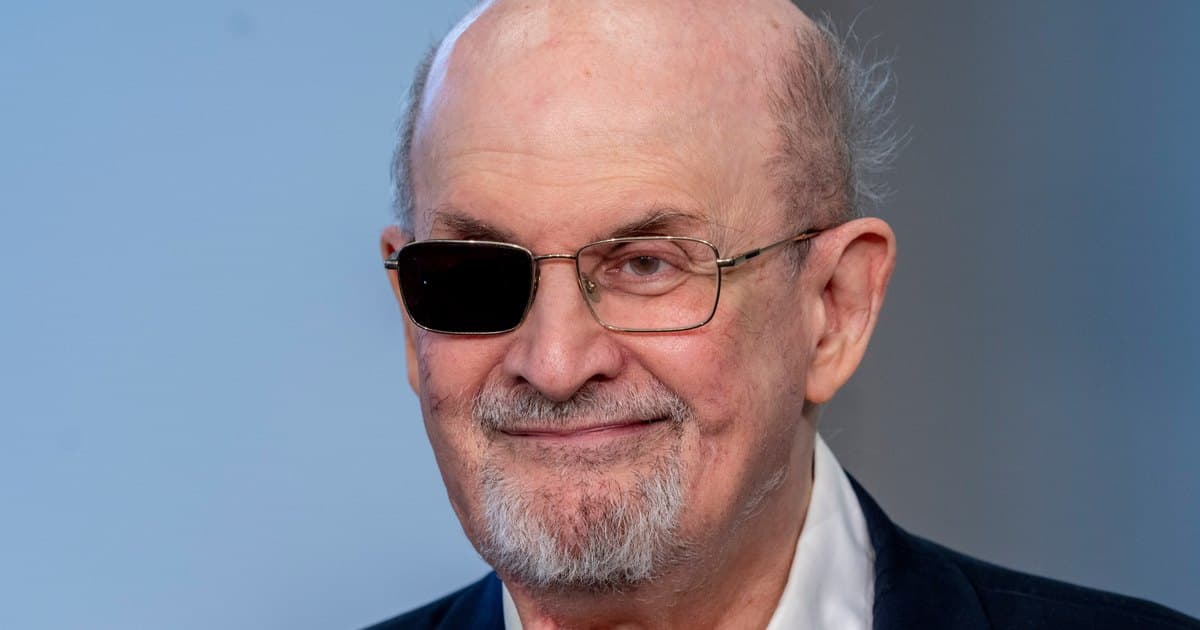
Salman Rushdie to Receive National Book Award Medal for Lifetime Achievement
Salman Rushdie will receive the National Book Foundation's medal for Distinguished Contribution to American Letters, presented by Kiran Desai on November 18.
Salman Rushdie will be awarded a National Book Award medal for lifetime achievement, the National Book Foundation has announced. The 79-year-old author, a U.S. citizen for the past decade, becomes the 39th recipient of the Distinguished Contribution to American Letters award and only the fourth winner born outside the United States, after Canada's Saul Bellow, Chile's Isabel Allende and Sweden's Art Spiegelman.
Rushdie, who was born in Mumbai and moved to England as a teenager, now lives in New York City with his wife, the author Rachel Eliza Griffiths. He described the honour as deepening his sense of belonging to American letters, comparing it to the shift he felt upon gaining citizenship after years of holding a green card.
"I remember somebody told me that when Ray Carver got some major American award, he described himself as being 'out there in literature now,'" Rushdie said in a recent interview. "And I thought, 'Maybe I'm out there in American literature now.'"
Longtime friend and fellow author Kiran Desai, herself an Indian immigrant, will present the medal at the National Book Awards ceremony in Manhattan on November 18, when prizes in five competitive categories will also be handed out.
At the same event, the foundation will honour pediatrician and literacy activist Perri Klass with the Literarian Award for Outstanding Service to the American Literary Community. Past recipients include Maya Angelou, Terry Gross and Roxane Gay. The foundation's executive director, Ruth Dickey, said Dolly Parton was offered the award several times in recent years but declined each time, saying she did not need the recognition. Parton died last month at 80.
Dickey praised Rushdie's body of work as a celebration of literature's power to build connections across borders, generations and identities, noting that his fiction moves across real and imagined landscapes.
Rushdie has published more than 20 books, including the Booker Prize-winning "Midnight's Children," often ranked among the greatest contemporary novels. He is also widely remembered for the 1988 novel "The Satanic Verses," whose references to the Prophet Muhammad prompted worldwide protests and a fatwa from Iran's Ayatollah Ruhollah Khomeini calling for his death. The author spent years in hiding before the threat appeared to recede, until he was stabbed repeatedly onstage in 2022 at a literary festival in western New York. A state jury convicted his assailant, Hadi Matar, of attempted murder, while a federal jury found him guilty of transnational terrorism and providing material support to Hezbollah.
Rushdie has since published a memoir about the attack, "Knife," and a story collection, "The Eleventh Hour." His sole competitive National Book Award nomination came in 2024 for "Knife," which is the basis for an Alex Gibney documentary of the same name scheduled for release on September 17.
Reflecting on his legacy, Rushdie invoked his late friend Martin Amis and said he would like to leave behind a shelf of books bearing his name. He describes his life as a three-part story spanning South Asia, London and New York, and places himself in a long tradition of immigrant writers alongside Bellow and younger authors such as Jhumpa Lahiri and Yiyun Li.
"I was an immigrant writer in England, and now I'm an immigrant writer in America," he said. "American writers come from everywhere."