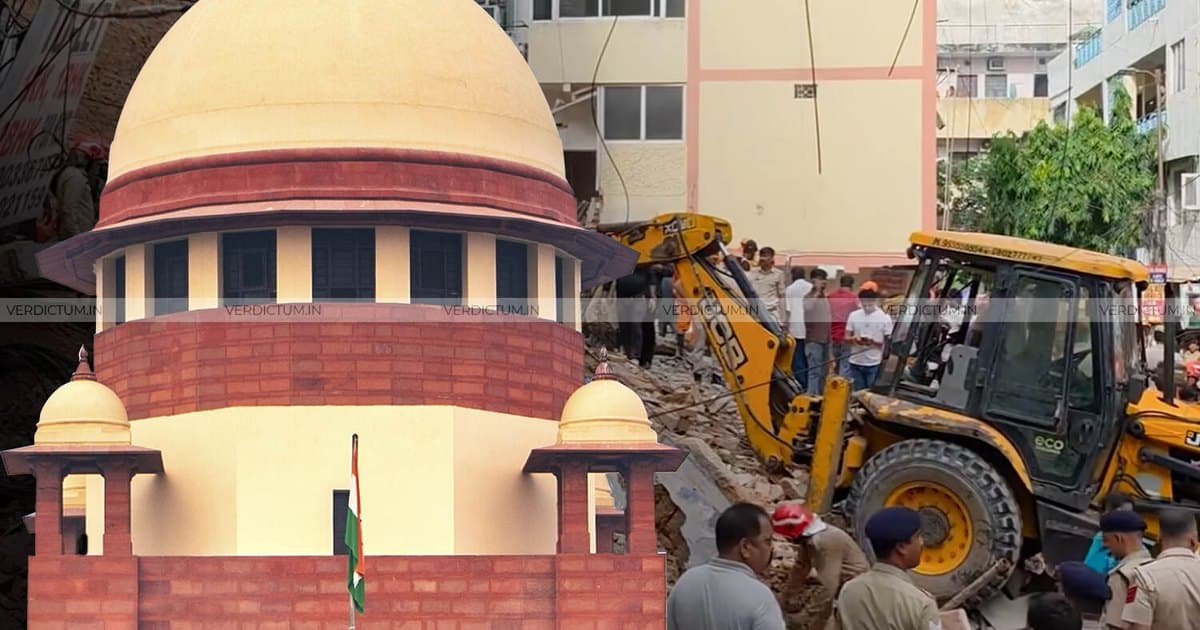
Supreme Court Leaves Satya Niketan Collapse Case with Delhi HC, Seeks Close Monitoring
The Supreme Court declined to transfer the Satya Niketan building collapse case to itself, asking the Delhi High Court to monitor compliance closely.
The Supreme Court on Thursday declined to take over proceedings relating to the Satya Niketan building collapse, choosing instead to let the Delhi High Court continue hearing the matter while monitoring compliance with its directions at short intervals.
A Bench of Justices Ahsanuddin Amanullah and R. Mahadevan was hearing proceedings that originated in a Tamil Nadu case concerning violations of land-use norms and building bylaws. In March, the Bench had widened that case and sought information from civic bodies in several State capitals, including Delhi, Lucknow, Jaipur, Chennai and Kolkata, on action taken against similar violations.
After an illegally constructed five-storey building being run as a paying guest facility collapsed in Satya Niketan on Sunday, killing seven people and injuring 12, the court-appointed amicus curiae, senior advocate Ajit Kumar Sinha, filed a status report. It urged the Bench to order a time-bound safety audit of PG facilities, private hostels and other student accommodation around colleges and universities across Delhi.
On Thursday, Mr. Sinha told the Bench that the Delhi High Court was already hearing a petition seeking a comprehensive probe into the collapse and had, on Monday, ordered an inquiry into the tragedy along with a safety inspection of PG facilities under the Municipal Corporation of Delhi's jurisdiction. He said the directions were being acted upon and urged the court to let the High Court continue monitoring compliance rather than transferring the proceedings.
The Bench accepted the suggestion. "We accept the suggestion of the learned amicus curiae, and for the present, do not disturb the position of the case before the High Court, which shall continue. The High Court is requested to monitor the case at short intervals," it said. It stressed that the High Court must ensure its earlier directions to the MCD to act against illegal constructions and the misuse of residential premises for commercial purposes were not diluted.
The decision followed an initial refusal by the Bench to entertain an oral request from Solicitor General Tushar Mehta, appearing for the Delhi government and the MCD, not to transfer the proceedings to itself. Mr. Mehta described the Satya Niketan tragedy as a local issue and pointed to steps already taken by the civic body, offering to file a report. The Bench asked him to have faith and assured him his apprehensions would be addressed, before acceding to the request once the amicus curiae endorsed it.
Mr. Sinha also informed the court that a court-appointed committee had carried out inspections under its earlier directions and identified several buildings in Saidulajab, Saket and Lajpat Nagar as potentially unsafe. Some of the buildings were found to be housing more than 500 people, he said, adding that demolition of illegal structures had begun in areas including Lajpat Nagar and Sarojini Nagar.
Pointing to the risks of such overcrowding, the Bench noted the lack of adequate access points in illegally constructed buildings, particularly those housing coaching centres. Justice Amanullah observed that coaching centres were the worst, packing hundreds of students into a single room with no proper ingress and egress.
The matter was posted for hearing on September 15 to review compliance affidavits filed by civic authorities on the court's earlier directions to identify illegal constructions within their jurisdictions and act without delay. The authorities had also been directed to clear public spaces and roads of stray cattle.
In his status report, Mr. Sinha also flagged an earlier building collapse in Satya Niketan in April 2022, which killed two people and injured four others. The recurrence of a fatal collapse in the same locality, he said, raised concerns about the effectiveness of existing inspection mechanisms. The report called for scrutiny of whether PG facilities and other student accommodation were operating in line with sanctioned building plans, permissible land use and structural and fire-safety requirements.