Sikkim's Three-Pronged Plan to Tackle Glacial Lake Outburst Flood Risks
Sikkim proposes solar-powered pumping and retention structures to reduce risks from Glacial Lake Outburst Floods.
The Sikkim government has put forward three engineering interventions aimed at reducing the threat posed by Glacial Lake Outburst Floods (GLOFs) in the state. The proposals target the Shako Chho lake, the Lhonak Valley, and the Gurudongmar lake complex, marking a shift from studying glacial hazards to implementing concrete mitigation measures.
Principal Secretary of the Science and Technology Department, Sandeep Tambe, said the focus is now on mitigation. "Studying glaciers is one thing, but we are mostly working towards glacial hazard mitigation," he noted.
At Shako Chho, situated at roughly 17,000 feet and about 12 km from Thangu, the plan involves lowering the lake's water level using solar-powered pumps. The lake holds an estimated 27 million cubic metres of water and has no natural outlet. Since the National Disaster Management Authority (NDMA) has cautioned against disturbing the fragile moraine, the proposal suggests pumping out around 8 million cubic metres initially, potentially reducing the lake level by 20 to 40 metres. Chief Engineer Ashim Basnett explained that reducing the lake's volume would lessen the force of water released in the event of an avalanche or landslide. Conventional pumping is not feasible due to the lack of electricity and the difficulty of transporting fuel to such altitudes. A Detailed Project Report has been submitted for central government review.
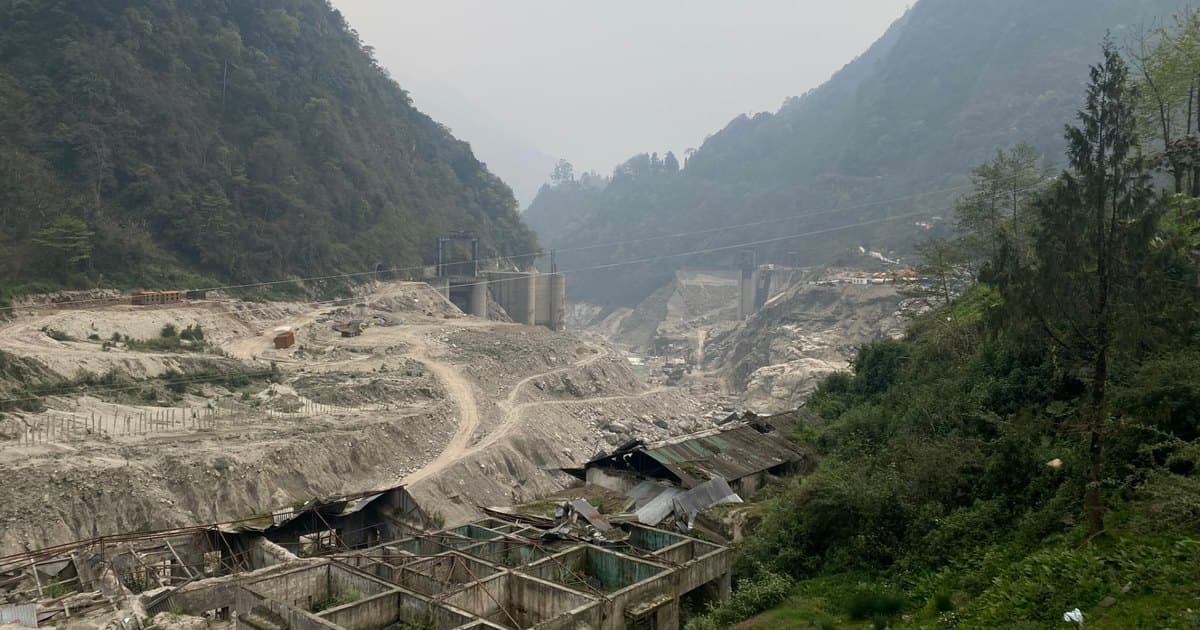
The second proposal focuses on the Lhonak Complex, which includes South Lhonak, North Lhonak, and Changsang lakes. Instead of intervening directly at the lakes, the state plans a retention structure at Dolma Sampa, about 24 km downstream near Muguthang, where the valley naturally widens. This site proved significant during the October 2023 South Lhonak GLOF, which released nearly 30 million cubic metres of water. The flood slowed down at Dolma Sampa as water and debris spread across the wider valley. Current assessments show South Lhonak is stable, with the combined water volume of the South and North Lhonak lakes estimated at 70-80 million cubic metres.
The third intervention concerns the Gurudongmar lake complex, which has expanded considerably over three decades. The proposal includes building a moraine-plug safety wall or stone-masonry structure at the lake outlet to regulate water release. S&T Secretary Dhiren Shrestha warned that once floodwater rolls down the valley, it gains momentum and picks up debris, making it nearly impossible to control.
Of the 40 high-hazard glacial lakes identified by NDMA in Sikkim, 16 are classified as priority Category-A lakes. Detailed assessments have been completed for 13 of them. The state is now evaluating which engineering interventions are technically viable while continuing monitoring efforts.