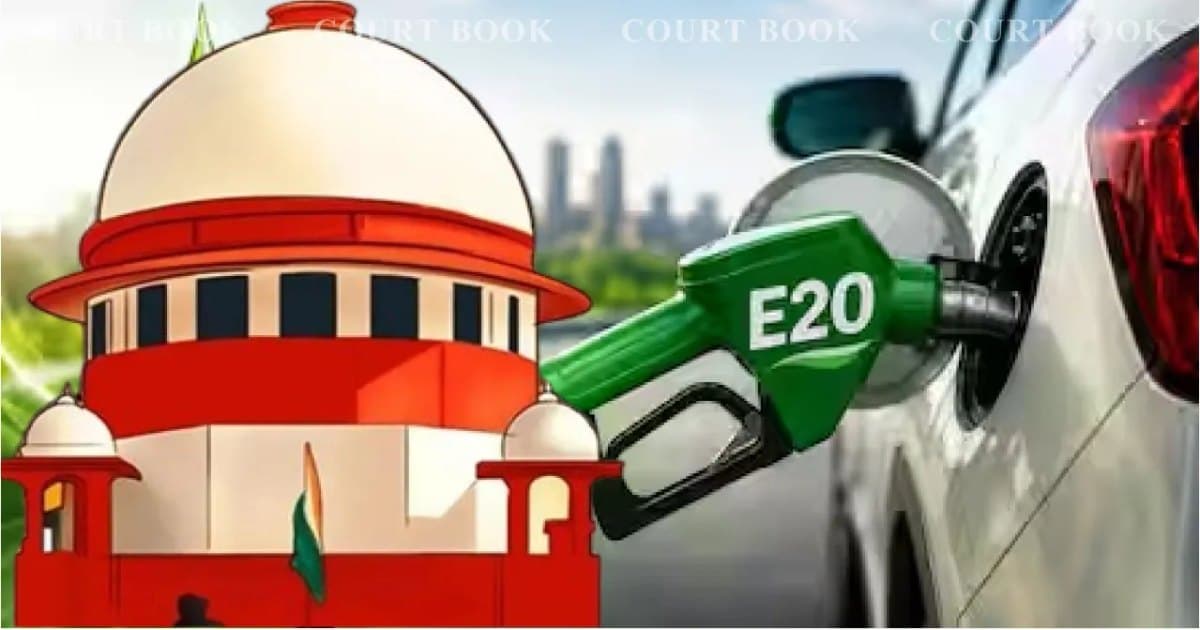
Supreme Court Refuses to Direct Ethanol Percentage Disclosure at Petrol Pumps
SC dismisses PIL seeking mandatory ethanol percentage labelling at petrol pumps, says petitioner can move high court.
The Supreme Court on Monday declined to entertain a public interest litigation that sought a directive to the Centre and other authorities to ensure every fuel dispensing nozzle at petrol pumps carries a uniform label disclosing the exact percentage of ethanol in the petrol being sold.
A bench of Justices M.M. Sundresh and P.B. Varale refused to hear the plea filed under Article 32 of the Constitution, which allows citizens to approach the Supreme Court directly for enforcement of fundamental rights. The court said the petitioner, Narendra Kumar Goswami, could instead approach the jurisdictional high court for relief.
"Petition dismissed. Open for petitioner to approach competent authority," the bench said in its order.
Attorney General R. Venkataramani, appearing for the central government, opposed the plea, noting that the court had earlier dismissed challenges to the ethanol blending policy itself. Goswami, however, clarified that he was not challenging the policy but only seeking disclosure of ethanol content in petrol.
"I am not challenging the policy. I just want to know. I have the right to know. Even when we buy a packet of biscuits we know the ingredients," he submitted.
The petitioner argued that citizens have a right to be informed about the composition of the fuel they purchase. He pointed out that E20 petrol—a blend of 20% ethanol and 80% petrol—does not carry any mention of its ethanol content at fuel pumps. He also sought a direction that every fuel invoice should clearly state the percentage of ethanol in the petrol sold.
Additionally, the plea asked for the creation of a public, vehicle-wise compatibility database indicating which vehicles can safely use various ethanol blends, and for the constitution of an expert committee to examine real-world impacts of E20 on fuel efficiency, engine longevity, maintenance costs, warranties, emissions, and food security.
The E20 programme is part of the government's strategy to cut crude oil imports and promote biofuels. However, concerns have been raised about its compatibility with older vehicles, potential corrosion in fuel systems, and reduced mileage. The government has previously said that mileage depends on multiple factors, not just fuel composition.
The Supreme Court's bench advised Goswami to raise his contentions before the high court, leaving the matter open for further legal recourse.