TRAI Drive Test Flags BSNL Coverage Gaps on Delhi-Agra Highway and Rail Routes
TRAI's July 2026 drive test on the Delhi-Agra highway and rail routes found BSNL trailing private operators on coverage, call drops and data speeds.
The Telecom Regulatory Authority of India has published the results of an independent drive test carried out along the Delhi-Agra highway and the Agra-Delhi railway corridor under the Delhi Licensed Service Area in July 2026. The exercise is intended to give consumers a real-world picture of mobile voice and data quality rather than relying solely on operator-reported figures.
Field teams covered a 183.4 km highway stretch on the Yamuna Expressway, passing through Dankaur, Jewar, Tappal, Surir, Javara, Baldeo, Khandauli and Kuberpur, along with a 188 km railway run from Agra to Delhi via Raja Ki Mandi Junction, Mathura Junction, Chata, Kosi Kalan, Palwal, Ballabhgarh and Faridabad. A single stationary hotspot — The Food Street food court at the Vrindavan cut on the Yamuna Expressway — was also tested. The drive was conducted between 16 and 17 July 2026 under the supervision of TRAI's Delhi regional office.
Live voice and data sessions were run using SIM cards from all telecom service providers across 2G, 3G, 4G and 5G networks, with multiple test handsets and real-time software monitoring. The parameters captured included coverage gaps, call setup success rate, drop call rate, call setup time, call silence rate, speech quality, download and upload throughput, latency, jitter and packet drop rate.
On the highway route, BSNL recorded poor signal strength in 4,876 of 12,619 voice samples, far higher than Airtel (180 of 13,960), Reliance Jio (145 of 13,268) and Vodafone Idea (44 of 13,327). Dropped calls stood at 2 of 65 established calls for Airtel, 16 of 68 for BSNL, 1 of 66 for Jio and none for Vodafone Idea. Call silence instances lasting more than three seconds were logged at 16 of 63 calls for Airtel, 2 of 57 for BSNL, none for Jio and 18 of 68 for Vodafone Idea.
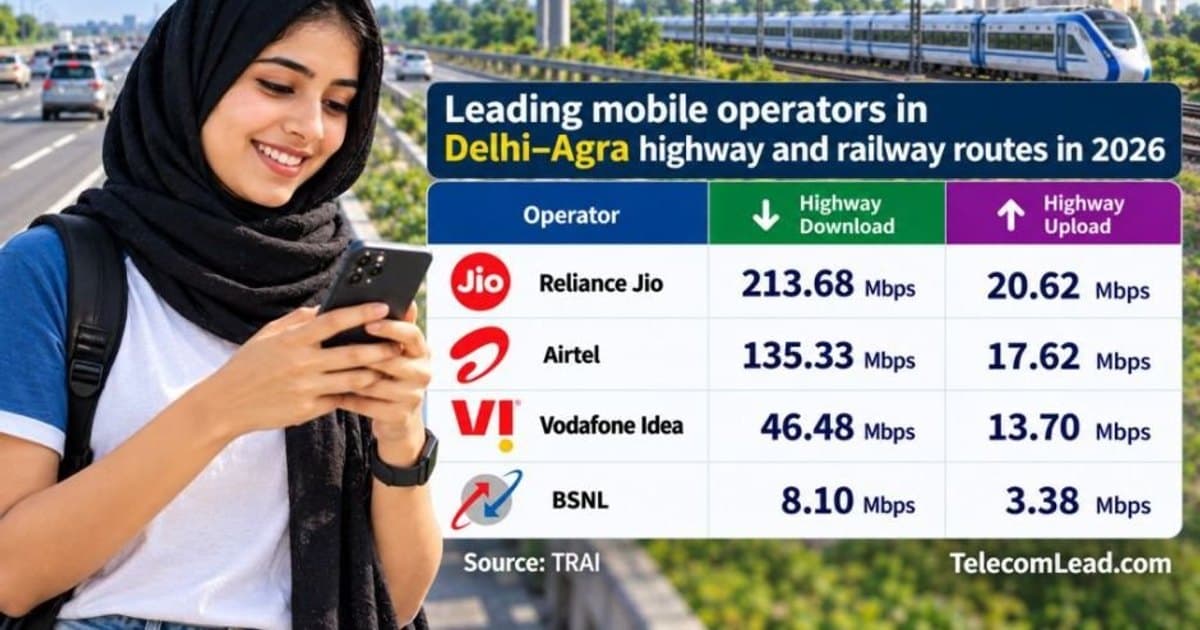
Average download speeds on the highway were 135.33 Mbps for Airtel on 5G, 8.10 Mbps for BSNL on 4G, 213.68 Mbps for Jio on 5G and 46.48 Mbps for Vodafone Idea on 5G. Upload speeds averaged 17.62 Mbps, 3.38 Mbps, 20.62 Mbps and 13.70 Mbps respectively.
On the railway route, coverage gaps were again widest for BSNL, at 5,264 of 10,895 samples, compared with 326 of 11,709 for Airtel, 286 of 11,697 for Jio and 224 of 11,728 for Vodafone Idea. BSNL also accounted for the most dropped calls, 12 of 60, while Airtel reported none, Jio three of 63 and Vodafone Idea two of 62.
Rail-route download speeds averaged 44.23 Mbps for Airtel (5G), 9.99 Mbps for BSNL (4G), 82.68 Mbps for Jio (5G) and 47.48 Mbps for Vodafone Idea (5G). Upload speeds were 13.32 Mbps, 5.07 Mbps, 10.14 Mbps and 12.31 Mbps respectively.
The findings have been shared with the individual service providers for corrective action. TRAI noted that the results reflect network performance only on the routes and at the times tested. Full reports, including maps pinpointing coverage gaps and dropped-call locations, are available on the authority's website.