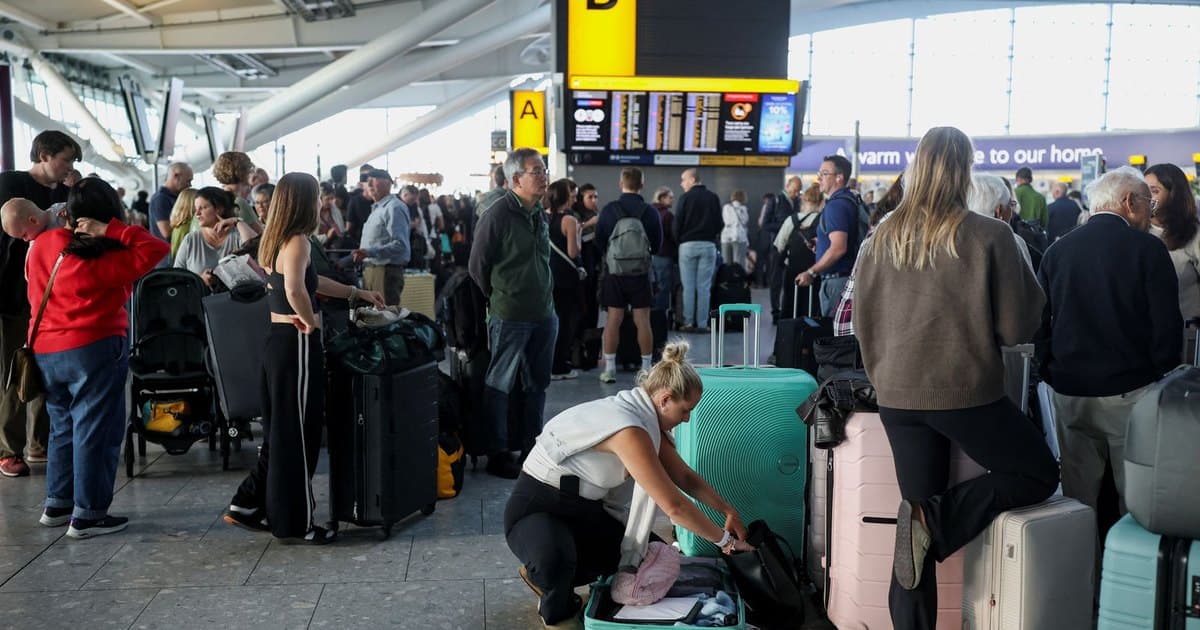
UK air traffic chief apologises after technical fault grounds over 600 flights
NATS chief Martin Rolfe apologises after a technical issue caused over 600 flight cancellations across UK airports, stranding passengers.
The head of Britain's air traffic control operator has apologised and defended the response to a technical failure that led to the cancellation of more than 600 flights, disrupting travel for tens of thousands of passengers.
Martin Rolfe, chief executive of NATS, said the company "absolutely takes responsibility" for the incident, which struck on Tuesday afternoon and affected airports across the UK, including London Heathrow, Gatwick, Stansted and Manchester.
"We never want this sort of thing to happen," Rolfe said in a statement. "I completely understand how frustrating it is for passengers. Nobody ever wants to be disrupted, whether they're going on holiday, on a business trip, trying to get home."
Rolfe explained that engineers worked "very hard" to resolve the problem, but admitted it took longer than expected. He stressed that such failures are "relatively rare" and that safety remained the priority.
"We're dealing with about 8,000 flights a day, sometimes 9,000 flights a day," he said. "Our job is to make sure those all happen safely. Clearly, we don't want things to go wrong. They go wrong relatively infrequently."
NATS said it had implemented a fix and that its flight processing system was "starting to recover" by the evening. However, the knock-on effects continued to ripple through the network, with airlines and airports working overnight to clear a massive backlog.
Flight-tracking website Flightradar24 recorded at least 625 cancellations to and from UK airports, affecting carriers such as British Airways, EasyJet, KLM and Lufthansa. Travel expert Simon Calder estimated that around 75,000 people had their plans disrupted, with another 25,000 stranded at various points across Europe.
Some passengers reported being stuck on runways for hours before their flights were eventually cancelled, while others complained about a lack of communication from airlines. EasyJet said some of its services were "unable to operate" and that the failure caused delays across Europe.
British Airways warned that some flights could be up to nine hours late, and dozens of morning arrivals were expected to be cancelled because aircraft were not in position. Calder described the situation as "simply shocking," noting the millions of pounds in costs to airlines and the "untold distress" for passengers.
Rolfe said NATS was working closely with airlines and airports to get as many people travelling as possible, but acknowledged that the disruption would take time to clear.