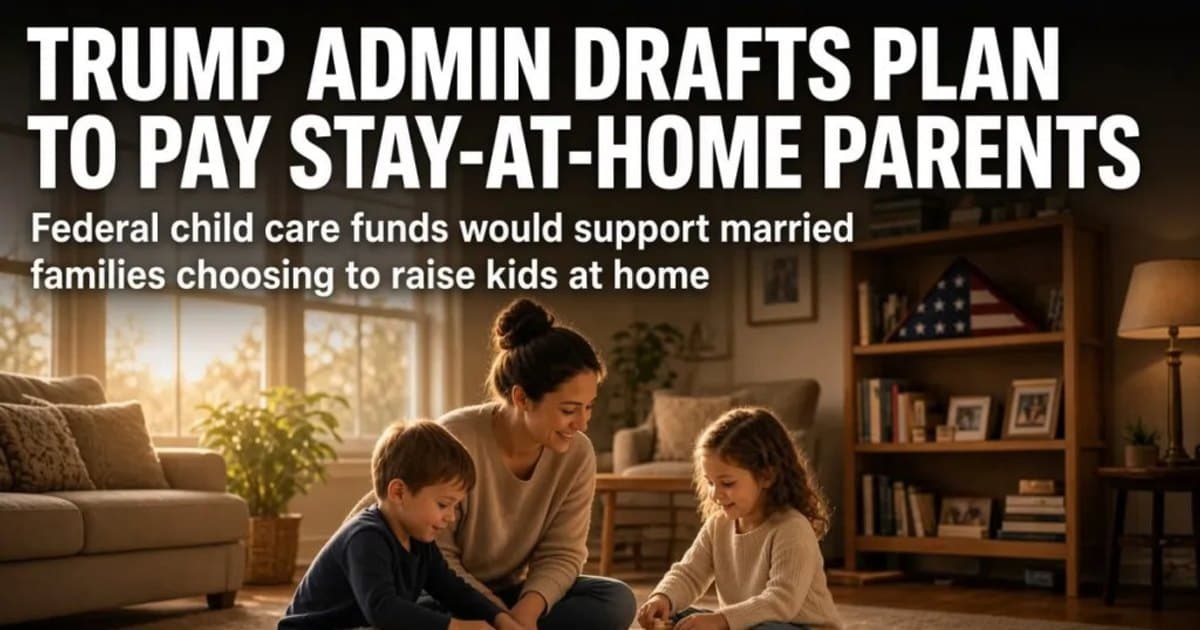
US Weighs Child-Care Funds for Stay-at-Home Parents in Married Couples
The Trump administration is considering a rule to let married couples with a stay-at-home parent receive federal child-care subsidies.
The Trump administration is preparing a significant shift in US federal child-care policy that could extend subsidies to married couples where one parent stays home to raise their children. The proposal, supported by Vice President JD Vance, would alter the traditional scope of the Child Care and Development Fund (CCDF), a programme run by the Department of Health and Human Services.
Currently, CCDF assistance is designed to help working and low-income parents pay for external child care so they can hold jobs, attend school, or pursue job training. Under the draft rule, a new category called "parent-based child care" would be introduced. This would allow one married parent to receive financial aid for caring for their own child, provided the other spouse works at least 35 hours per week.
The subsidy would effectively compensate families for some of the income lost when one parent chooses not to work outside the home. The programme currently provides roughly $9,000 per child annually.
Eligibility would be restricted to married couples meeting specific income limits. Household earnings generally must fall below 85% of the state's median income, though some states use a lower 60% threshold. Unmarried couples with a stay-at-home parent and single non-working parents would not qualify under the proposed change.
If implemented, this would mark a notable departure from the programme's original purpose, which was established in the 1990s to support workforce participation among low-income families. The change would instead allow federal funds to support in-home parental care, a move that could reshape how child-care assistance is understood and distributed.