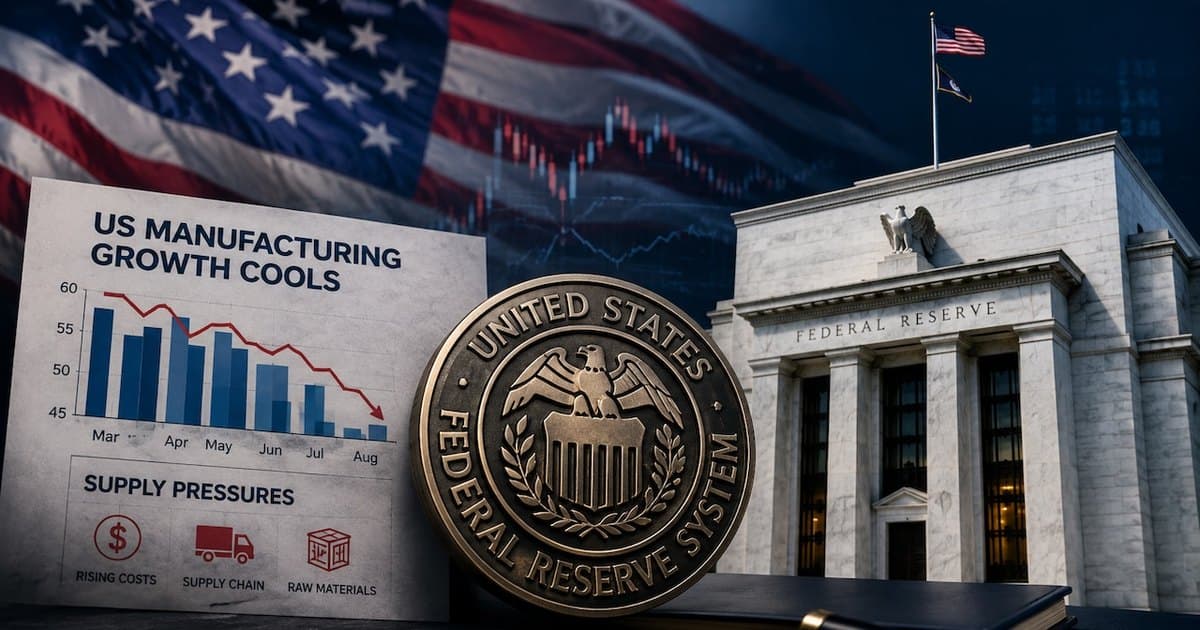
US factory growth cools in August as input costs stay high
US manufacturing growth slowed in August while input prices remained elevated, and job openings rose in July, keeping the Fed on track for a possible rate hike.
US manufacturing activity lost some momentum in August, with new orders easing and businesses flagging persistent price pressures linked to tariffs, the Middle East conflict, and an AI-driven buildout. The Institute for Supply Management's manufacturing PMI slipped to 54.6 from 55.6 in July, which had been the highest reading since May 2022. A reading above 50 still indicates expansion, and the sector has stayed in growth territory all year.
Manufacturers reported that input costs remained elevated, with the prices-paid index holding at 71.1. Steel and aluminum prices, driven by Section 232 tariffs, were a particular concern, with transportation equipment makers saying profitability was under pressure. Chemical producers described the economy as "annoying" and said tariffs and the conflict in the Strait of Hormuz were making it hard to compete. Machinery makers noted rising prices across all goods and said they had shifted more production offshore to manage costs.
The AI boom continued to support demand, especially for electronics, but also pushed up prices for components like semiconductors and memory chips. Fifteen manufacturing industries reported growth in August, including primary metals, textile mills, and transportation equipment, while wood and chemical products contracted.
Separate data from the Labor Department showed job openings rose by 89,000 to 7.271 million in July, though June's figure was revised down sharply. Hiring fell by 278,000 to 5.054 million, while layoffs dropped to 1.666 million. The ratio of job openings to unemployed workers ticked up to 1.05 from 1.01, suggesting the labor market remains balanced.
The combination of firm price pressures and a stable jobs market has kept expectations alive for a Federal Reserve rate hike at its September 15-16 meeting. Markets are pricing in about a 66% chance of a 25-basis-point increase. Fed Chairman Kevin Warsh said last Friday that policymakers will "have work to do" if they do not gain confidence that inflation is moving toward the 2% target.