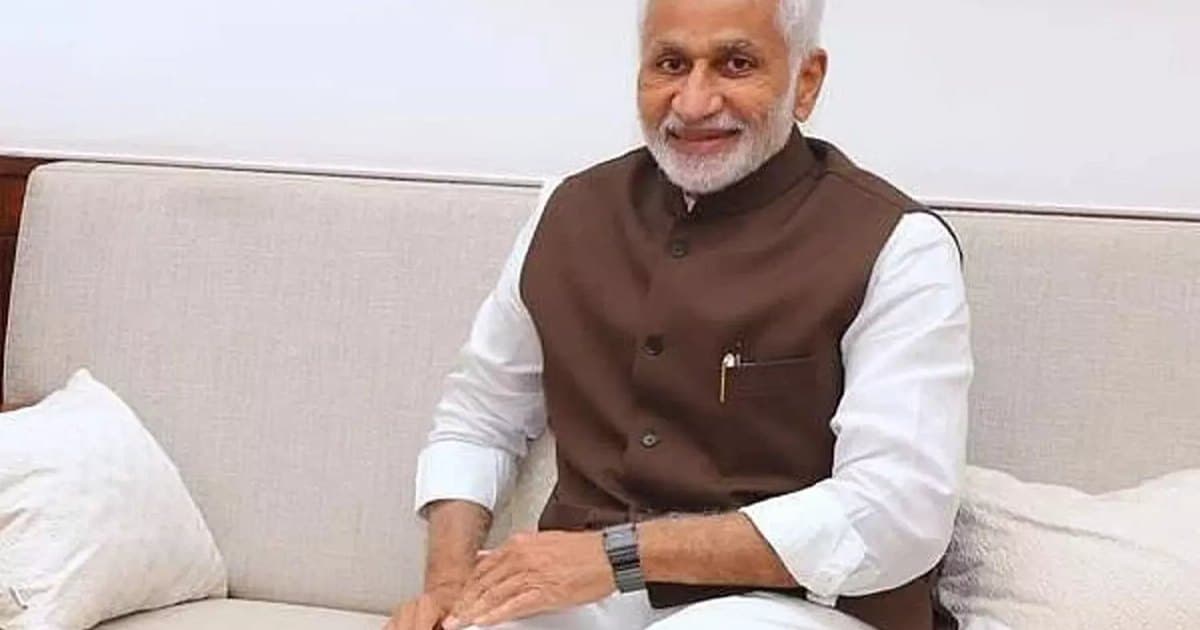
Vijayasai Reddy to launch new Andhra party after Vijaya Dasami
Former MP V. Vijayasai Reddy announced plans to float a new regional party in Andhra Pradesh after Vijaya Dasami, positioning it as a corruption-free alternative.
Former Member of Parliament V. Vijayasai Reddy on Monday said he would float a new political party in Andhra Pradesh after Vijaya Dasami, describing it as a "viable alternative" to the ruling Telugu Desam Party (TDP), YSR Congress Party (YSRCP), and Jana Sena Party. He made the announcement at a press conference, outlining the party's broad agenda and structure.
Mr. Vijayasai Reddy said the party's name and other formalities would be revealed after the festival. He clarified that neither he nor any family member would be the party's chief ministerial candidate in the 2029 elections. Instead, he intends to serve as a mentor, drawing a parallel with Bal Thackeray's role in Maharashtra's politics.
The proposed outfit will be strictly regional, limited to Andhra Pradesh, citing resource constraints for expanding into Telangana. Its primary objective, he said, is to eliminate corruption and end the politics of vindictiveness that he alleged is practised by the TDP and YSRCP, comparing it to past political rivalries in Tamil Nadu.
In a key structural decision, 66% of the party's seats would be reserved for candidates aged between 25 and 40 years, irrespective of caste, to empower the youth. Mr. Vijayasai Reddy claimed that people in the state are disillusioned with the existing major parties and are seeking a third alternative. He dismissed the Congress, CPI(M), and CPI as incapable of challenging the current political forces.
He referred to the TDP as the "red book party" and the YSRCP as the "rappa rappa party," while stressing that the new party would treat rivals as political opponents, not enemies. On possible pre-poll alliances, he said decisions would depend on the prevailing circumstances.
The party's manifesto, he said, would focus on five major goals: reducing prices of essential commodities and boosting incomes; providing free electricity to households and farmers through a mix of Central subsidies and solar power, with the government purchasing surplus generation; lowering taxes on petroleum products; expanding water storage capacity to 3,000 TMCFT; and strengthening government schools while offering a "graduate bridge allowance" to unemployed graduates.