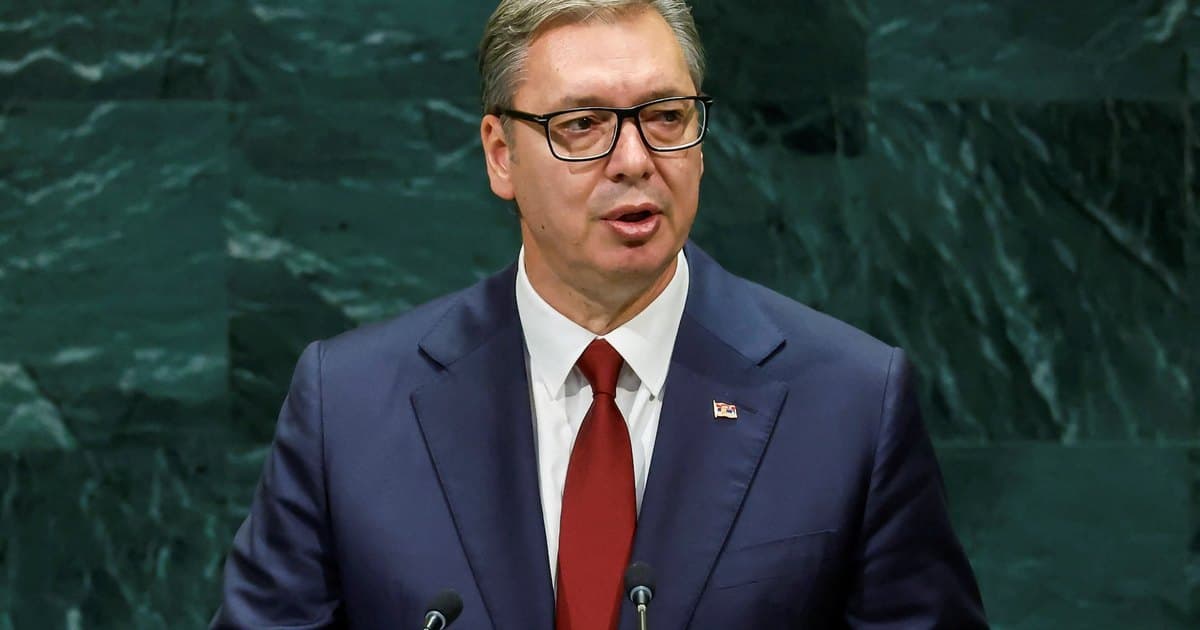
Vucic Resigns Serbian Presidency to Seek Prime Minister's Post
Serbia's Aleksandar Vucic has resigned as president to lead his party into an early parliamentary election and pursue the prime ministership.
Serbia's President Aleksandar Vucic resigned on Sunday, positioning himself to run for prime minister in an early parliamentary election set for October 25. The move gives the country's dominant political figure a fresh route to power after roughly twelve years alternating between the presidency and the premiership.
Vucic, 56, is barred by the constitution from a third presidential term, having already served two five-year mandates, the second of which was to run until May next year. He said he was stepping down in order to lead his right-wing Serbian Progressive Party, or SNS, into the vote. Although resigning was not a legal prerequisite for campaigning, it clears the way for him to seek the more powerful office of prime minister should the SNS-led bloc keep its grip on parliament.
Parliament Speaker Ana Brnabic, a close ally and former prime minister, becomes acting president. Under the rules, a presidential election must be held within three months of the resignation.
The parliamentary contest follows nearly two years of political turbulence and mass demonstrations that have amounted to the most sustained challenge to Vucic's rule. The unrest was set off by the collapse of a concrete canopy at the railway station in the northern city of Novi Sad on November 1, 2024, which killed 16 people. University students initially pressed for accountability over the disaster and for investigations into possible corruption and negligence, before their movement broadened into a wider campaign against graft and for stronger institutions and the rule of law.
The student movement is now preparing to contest the election with a list drawn largely from little-known professors, teachers, experts, athletes and other figures, and groups of students have cycled around Serbia as part of their campaign. The ruling populists face that movement along with established opposition parties, Vucic's Socialist allies and several smaller parties. The vote is expected to test whether the political system Vucic has dominated for more than a decade can withstand a movement built largely outside the traditional opposition establishment.
Vucic has answered with an intensive nationwide campaign. In recent weeks he has crisscrossed Serbia in appearances heavily covered by pro-government media, opening roads, offering assistance and cheaper medicines, and visiting voters at home. He has repeatedly pointed to what he describes as his government's economic and infrastructure achievements, acknowledged making mistakes while saying he has worked diligently for the country, and vowed to campaign everywhere and "listen to the people."
Under Serbia's political system the prime minister is formally more powerful than the president, yet Vucic has in practice wielded extraordinary influence from the presidency. Across his two terms he frequently addressed the nation, appeared on pro-government television and at times presided over government sessions or announced major government decisions.
The European Parliament and other international observers have repeatedly flagged concerns about the overlap between the ruling party, state institutions and Vucic's political activity. In its assessment of Serbia's 2023 elections, the European Parliament cited the president's dominant role in campaigning, misuse of public resources, pressure on public-sector employees and an uneven media environment. The Independent Bureau for Social Research, known as BIRODI, has also filed a complaint alleging that Vucic used a public institution to promote his party. Vucic has rejected such accusations, and the allegations have not been established as fact by an independent judicial finding.