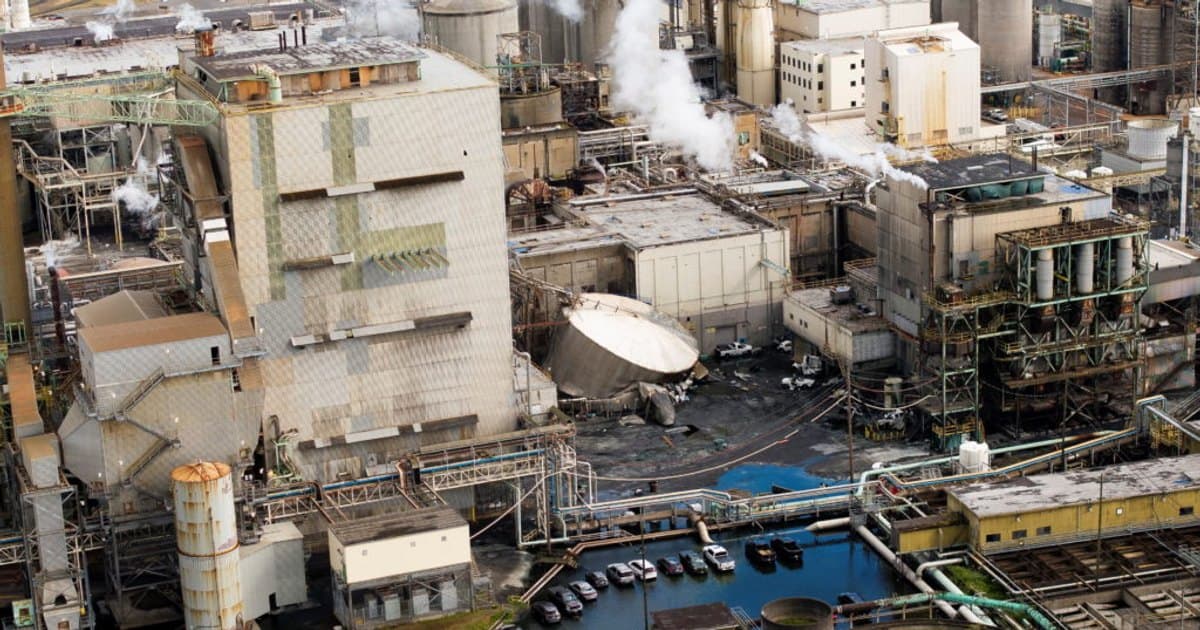
Washington Pulp Mill Had Long Record of Safety Lapses Before Fatal Blast
Records show a Washington pulp mill had years of safety complaints, maintenance failures and toxic chemical releases before a fatal tank collapse killed 11 workers.
A Washington state pulp mill where 11 workers died in a chemical tank collapse in May had a long history of safety complaints, poor maintenance and toxic chemical releases, according to state and federal records.
State inspectors had planned to visit the Nippon Dynawave Packaging Co. plant in Longview the week of the tragedy to interview workers about two unrelated safety complaints. Those plans were disrupted when the tank failed, releasing a large volume of caustic liquid capable of causing severe burns.
The state Department of Ecology had issued 54 environmental violation notices against the company since 2016, fining it $41,500 for eight serious violations. The Department of Labor and Industries investigated more than a dozen safety complaints at the plant since 2018 and issued nearly $7,000 in fines.
More than $2.4 million in workers' compensation claims have been paid for 169 employees injured on the job since 2015, including injuries related to caustic substance exposure. The mill, which employs 530 workers, produces pulp for paper goods.
Experts say the pattern of equipment failures and safety violations is a red flag. "My impression, you put it all together, including the most recent tank collapse, is it is a site that has not been maintained, and that creates risk to employees and risk to public," said Stephen Kmiotek, a chemical engineering professor at Worcester Polytechnic Institute.
The U.S. Chemical Safety Board reported last week that the company knew the tank was "not fit for continued service" months before the failure but continued using it. The state Department of Ecology filed a violation notice listing 35 citations after the accident.
A company spokesperson declined to comment on the records, saying they are working with regulators and will not comment on individual findings while the investigation is ongoing.
A wrongful-death lawsuit has been filed by the mother of two brothers killed in the accident, claiming the company failed to maintain equipment, train employees and implement safety procedures.
Records also show an employee complained in March about a detached valve handle on an ammonia clarifier tank, creating hazards for delivery drivers. The Department of Labor and Industries planned to send an inspector on May 26 — the day of the catastrophic failure.
Investigators later cited the plant for failing to inspect and maintain pipes, hoses and valves, and for not keeping inspection records. The fine of $2,890 was the highest imposed on the plant in the last decade.
Other incidents include an April 9 report of a worker falling into a sinkhole while fixing a stuck valve, becoming submerged in hot stock. The worker said a drain valve had been plugged since last year and never closed completely.
Between 2017 and 2023, the U.S. Environmental Protection Agency received eight reports of methyl mercaptan releases from the plant. Methyl mercaptan is a colorless flammable gas that can cause headache, dizziness, nausea and death. A 2014 leak of the same chemical at a DuPont plant in Texas killed four workers.
Residents regularly reported noxious smells around the plant over the past decade. Ecology officials fined Nippon $4,500 in 2024 for releasing excessive sulfur dioxide.
In 2020, 250,000 gallons of black liquor, a caustic chemical, discharged from a storage tank due to equipment failure. Ecology considered this a violation but did not take enforcement action. Equipment failure also caused a chlorine release in 2021, with additional leaks in 2024 and 2025.
In August 2021, about 3,000 gallons of white liquor was released from a storage tank because a valve was open, with some entering a storm drain. Fire investigators attributed a 2023 fire at the mill to old equipment involving a conveyor belt and burned wood.