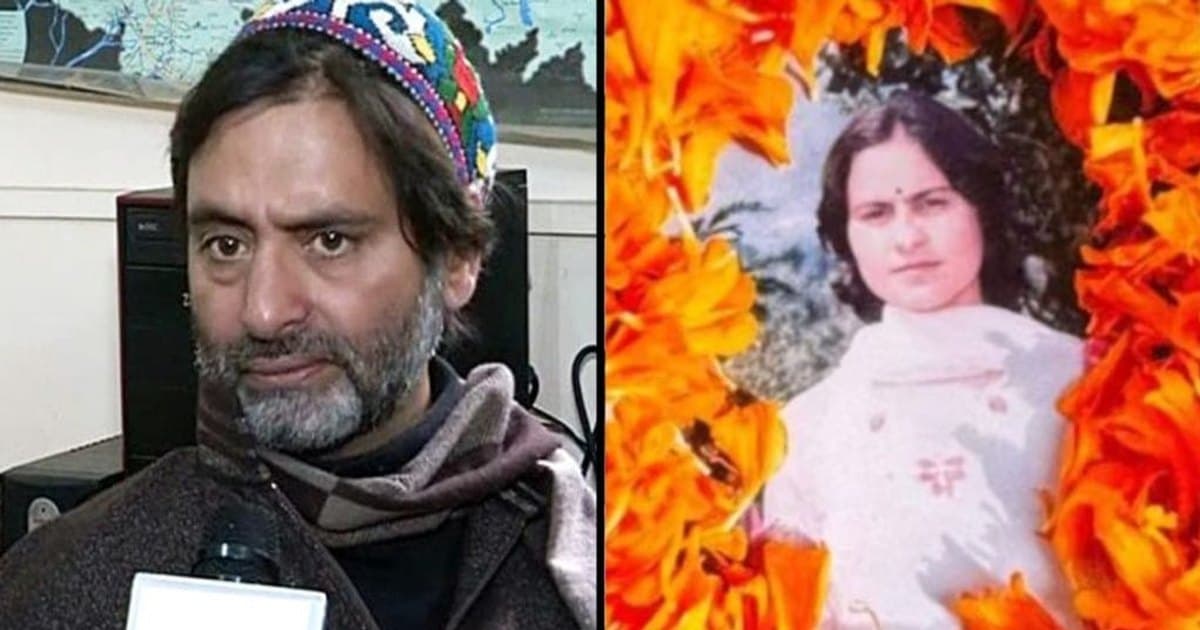
Yasin Malik denies role in Sarla Bhat killing, cites coma in April 1990
JKLF chief Yasin Malik denies involvement in Sarla Bhat's killing, saying he was in a coma in April 1990 and learnt of her death months later.
Jammu Kashmir Liberation Front (JKLF) chief Yasin Malik has formally denied any role in the abduction and killing of Kashmiri Pandit nurse Sarla Bhat, stating that he only became aware of her death in February 1991 — nearly ten months after the incident.
In a 25-page affidavit filed before the Additional Sessions Judge (TADA/POTA) Court in Srinagar, Malik responded to allegations made in a chargesheet filed by the State Investigation Agency (SIA) in June. The SIA's 737-page chargesheet, submitted to a special NIA court, names Malik as a key accused in Bhat's killing.
The SIA has alleged that Bhat was killed on the JKLF's assumption that she was passing information to security forces. Malik termed this assertion "deeply offensive to the memory of the deceased," noting that Bhat and her family chose to remain in the Valley after the mass migration of Kashmiri Pandits began in January 1990.
Malik recounted that on the day of the incident in April 1990, he was at a house in Hafiz Bazaz with associates Showkat Bakshi, Javed Zargar, and Iqbal Gandroo. Within about 20 minutes, the premises were raided by the Border Security Force (BSF). He said he jumped from the fifth floor to escape, sustaining grievous injuries and losing consciousness.
He stated that he remained in a coma for many days and was "declared dead on two occasions" — on 8 April 1990 and again on 27 April 1990. Malik argued it is "incomprehensible" that a person unconscious and fighting for survival could have orchestrated the alleged offence.
Malik also referenced subsequent dialogue with the government, mentioning meetings with former Intelligence Bureau Special Director Ajit Kumar Doval and then National Security Advisor Brajesh Mishra.
In the affidavit, Malik claimed he was falsely implicated due to "political circumstances and decisions." He also addressed his wife Mashal, who lives in Pakistan, requesting her to "find the courage to begin a new chapter of your life with dignity and hope."
Officials had earlier described the chargesheet as a "historic milestone" in investigating legacy terror crimes in Jammu and Kashmir.